 Rare Leaf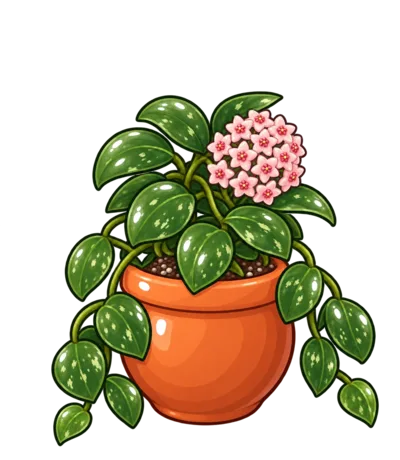
Hoya Carnosa (Wax Plant) Care: Light, Watering, Blooms and Propagation
Hoya carnosa · Apocynaceae
Hoya carnosa, the wax plant, is a vining houseplant with thick, glossy leaves and round clusters of fragrant, waxy, star-shaped flowers. It is long-lived, forgiving of the occasional missed watering, and once it starts blooming it reflowers from the same spurs year after year. The variegated cultivars with pink and cream leaves are some of the most popular hoyas you can buy.
How to identify Hoya carnosa
Wax plant is an evergreen climber that grows up trees and rocks in the wild. The leaves are glossy, dark green, elliptic and fleshy, up to about 4 inches long according to the Missouri Botanical Garden. Indoors, the thin stems twine around a wire hoop or trellis, or trail from a hanging basket.
The flowers come in tight, dome-shaped clusters (umbels). Each flower is about half an inch across, white to pale pink, with a red, five-pointed star in the center. A single cluster can hold up to 30 flowers, and they are most fragrant in the evening.
Hoya belongs to the dogbane family, Apocynaceae. Older sources, including the ASPCA, still list it under Asclepiadaceae, the former milkweed family that is now included in Apocynaceae. Kew’s Plants of the World Online gives its native range as southern China to Laos, southern Japan and Taiwan.
Light
Green leaves are fine in bright, indirect light, but a hoya needs more light to bloom. The RHS recommends a bright spot out of hot summer sun, and the Missouri Botanical Garden says it does well with some direct sun, such as morning sun in an east window. Low light is the number one reason a hoya won’t flower.
Once flower buds appear, don’t rotate or move the plant. A change in light can make the buds drop.
Watering
The thick leaves store water, so a hoya handles short dry spells much better than wet feet. Water thoroughly, let the excess drain away, then let the potting mix get nearly dry before you water again. Never leave the pot sitting in a saucer of water.
From October through February, water less and keep the mix on the dry side without letting it dry out completely. The RHS names waterlogged compost in a cool winter as the main cause of root rot, blackened leaves and leaf drop. NC State Extension recommends room-temperature water, since cold water can shock the plant.
Soil and repotting
Use a chunky, fast-draining mix. The RHS suggests equal parts orchid bark, peat-free all-purpose potting mix and coarse perlite. The pot must have a drainage hole.
Hoyas dislike repotting and can stay in the same pot for years. Repot in spring only when roots fill the pot, and go up just an inch or two in size. The RHS advises waiting five to six weeks after repotting before you fertilize.
Humidity and temperature
Average household humidity is fine; the plant appreciates more in hot weather. The RHS suggests setting the pot on a tray of damp gravel or clay pebbles, with the water level below the top of the stones.
The RHS gives an ideal growing range of 61–75°F (16–24°C), with a cooler rest in winter but not below 50°F (10°C). Keep it away from heaters and cold drafts. It can spend summer outdoors, but bring it in before nights drop below 50°F.
Fertilizer
From spring through summer, feed lightly about every two weeks with a balanced fertilizer; the RHS mentions orchid fertilizer. Cut back to once a month or less in fall and winter. Flush the pot with plain water now and then to prevent salt buildup.
Pruning and blooming
The key rule: do not cut off the spent flower stalks. New clusters grow from the same short spurs. You can trim weak or crowded stems in late winter, but hoyas do not respond well to hard pruning. Wear gloves, because the milky sap can irritate skin.
Be patient with young plants. NC State Extension notes that hoyas typically don’t bloom until they are two to three years old.
How to propagate Hoya carnosa
Stem cuttings root easily. The RHS recommends spring or early summer.
- Pick a mature stem from last year’s growth with two or three pairs of leaves and at least one node.
- Cut just below a node with a clean knife and remove the lowest pair of leaves.
- Stand the cutting in a glass of water with the node submerged and the leaves above the waterline. Change the water when it gets cloudy.
- Wait for roots. The RHS says they usually form in two to three weeks.
- Pot it up in a peat-free cutting mix and water carefully for the first few weeks.
You can also layer a hoya: bend a long stem into a second pot of mix, pin a node against the surface and keep it moist. Once it has rooted, cut it from the mother plant.
Variegated Hoya carnosa cultivars
- ‘Tricolor’ (sold as ‘Krimson Queen’): the RHS describes mid-green leaves splashed with cream and flushed pink when young. NC State Extension describes a green center with creamy white to pink margins.
- ‘Krimson Princess’: green leaves with pink and white variegation.
- ‘Exotica’: leaves flushed yellow and variegated pink, according to the RHS.
- ‘Compacta’ (‘Krinkle Kurl’, Hindu rope) is not variegated, but its folded, crowded leaves give the stems a rope-like look.
Common problems
| Symptom | Cause | Fix |
|---|---|---|
| No flowers | too little light, young plant, flower spurs cut off | move to brighter light, leave spurs, be patient |
| Buds drop | plant was moved or light changed | don’t move the pot while it’s in bud |
| Leaves blacken and drop | wet mix in winter, cold | water less, keep above 50°F |
| Wilting, stem dieback | overwatering or overfeeding | let the mix dry, feed more lightly |
| Root rot | constantly soggy mix | plants rarely recover; take cuttings early |
| White cottony spots in leaf joints | mealybugs | see mealybugs on houseplants |
| Fine speckling, webbing | spider mites in dry air | raise humidity, see spider mites |
| Small flies over the soil | fungus gnats in wet mix | water less, see fungus gnats |
The RHS also lists scale insects and greenhouse whitefly. Check leaf undersides and the base of the flower spurs.
Is Hoya carnosa toxic to pets?
The ASPCA lists Hoya carnosa as non-toxic to dogs, cats and horses, and NC State Extension rates it the same way. That makes it a popular choice for homes with pets, although any plant material can cause mild stomach upset if a pet eats a lot of it.
For people, the RHS warns that the milky sap can irritate skin. Wear gloves when you prune or take cuttings, and keep the sap away from your eyes.
Variegated & notable cultivars
- 'Tricolor' (syn. 'Krimson Queen') — cultivar
- 'Krimson Princess' — cultivar
- 'Exotica' — cultivar
FAQ
Why is my hoya not blooming?
Usually not enough light. Young plants also tend not to flower until they are two to three years old. Leave the old flower spurs in place and do not move the pot once buds have formed.
Should I cut off hoya flower stems after blooming?
No. Both the RHS and the Missouri Botanical Garden advise leaving the spurs on the plant, because new flower clusters form on the same spurs.
How often should I water a Hoya carnosa?
Let the potting mix become nearly dry between waterings. Water more often in summer and sparingly from fall through winter, but do not let the root ball dry out completely. Soggy soil in cool weather causes root rot.
Is Hoya carnosa toxic to cats and dogs?
The ASPCA lists Hoya carnosa as non-toxic to dogs, cats and horses. The RHS notes that the milky sap can irritate skin, so wear gloves when pruning.
How long does it take a hoya cutting to root in water?
According to the RHS, cuttings standing in a glass of water usually form roots in two to three weeks.
Is Krimson Queen the same as Tricolor?
The RHS lists Krimson Queen as a synonym of Hoya carnosa Tricolor. Krimson Princess is a different cultivar.
Sources
- ASPCA — Wax Plant (Hoya carnosa)
- RHS — How to grow hoya
- NC State Extension — Hoya carnosa
- Missouri Botanical Garden — Hoya carnosa
- RHS — Hoya carnosa 'Tricolor' (v)
- RHS — Hoya carnosa 'Exotica' (v)
- POWO (Kew) — Hoya carnosa
Care information is general; every plant and home is different. Growing is simplified in the game.