 Rare Leaf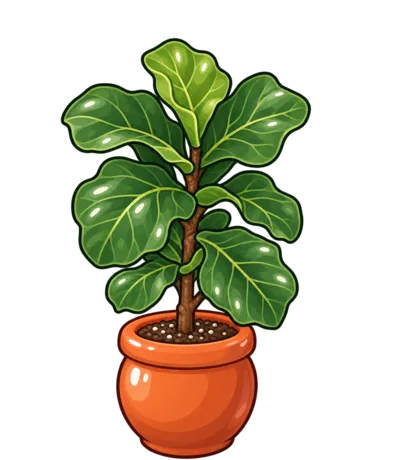
Fiddle Leaf Fig Care (Ficus lyrata): Light, Watering and Why Leaves Drop
Ficus lyrata · Moraceae
The fiddle leaf fig (Ficus lyrata) is an indoor tree with huge, wavy, violin-shaped leaves. It became the signature plant of modern interiors and also earned a reputation for dropping leaves at the slightest provocation. In practice, most problems come down to three things: light, watering and a steady temperature.
How to identify a fiddle leaf fig
Ficus lyrata is a member of the fig and mulberry family (Moraceae). Kew’s Plants of the World Online gives its native range as West and west-central tropical Africa, where it grows as a hemiepiphytic tree in wet tropical forest. The Missouri Botanical Garden notes it can reach 60–100 feet in the wild but typically stays 2–10 feet as a houseplant. It is also called banjo fig, and the name lyrata refers to the lyre-shaped leaf.
The leaves are big, leathery and puckered, up to 18 inches long according to NC State Extension, with a broad rounded tip that resembles a fiddle. Cut stems bleed milky sap. The small round figs are rarely seen on indoor plants.
Light
Fiddle leaf figs want a lot of light. NC State Extension recommends bright indirect light or partial shade, and the RHS lists full or filtered light. A few hours of morning or evening sun is beneficial, but harsh midday sun through glass will scorch the leaves.
The best spot is as close as possible to a large window. In a dim corner the plant barely grows, and University of Florida guidelines name low light stress as a cause of green leaf drop.
Be careful with moves. Plants grown in bright nursery conditions have to adjust to lower indoor light, so losing a few leaves in the first weeks at home is not necessarily a care mistake. Once you’ve found a good spot, leave the plant there.
Watering
The RHS advises watering regularly during the growing season, letting the top of the mix feel dry before you water again. In winter, keep it just barely moist. NC State Extension notes the plant is sensitive to overwatering and drops leaves from both too much and too little water.
Water thoroughly until it drains from the bottom, then empty the saucer. Grower Costa Farms suggests watering once the top couple of inches dry out, and erring on the dry side if you’re unsure.
Soil and repotting
The RHS recommends a peat-free, loam-based potting mix, and NC State Extension suggests a loamy, slightly acidic, well-drained soil. Repot about every couple of years in spring into a pot only slightly larger. For tall plants that are hard to repot, refreshing the top layer of mix is an option.
Humidity and temperature
NC State Extension recommends medium relative humidity. The RHS suggests standing the pot on a saucer of damp clay pebbles or gravel, with the pot above the water line. Dry air tends to show up as crispy brown leaf edges.
Keep it above 50–55°F (10–13°C). University of Florida guidelines consider 65–80°F (18–27°C) most appropriate for indoor figs. Stability matters more than the exact number: the RHS warns against sudden temperature drops and cold drafts, and NC State Extension ties brown spots to temperature fluctuations from heating or cooling vents.
Fertilizer
Feed with a high-nitrogen fertilizer from spring through late summer to support leafy growth, and stop in winter. Wipe the leaves with a damp cloth now and then to remove dust.
How to propagate a fiddle leaf fig
NC State Extension lists stem cuttings as the recommended method, and the RHS suggests semi-ripe fig cuttings in spring or summer in a heated propagator:
- Put on gloves. NC State Extension notes the sap can irritate skin.
- In spring or summer, cut a healthy stem tip with a few leaves, just below a leaf.
- Remove the lower leaves.
- Insert the cutting into moist, free-draining propagation mix.
- Keep it warm and bright, out of direct sun, ideally in a heated propagator or under a clear cover.
- Keep the mix lightly moist. Once the cutting starts growing, pot it up on its own.
On a mature plant you can also air layer a branch. University of Florida guidelines list air layering among the main propagation methods for Ficus. The technique is the same as for the rubber plant.
Varieties
NC State Extension lists the dwarf ‘Bambino’, which stays small, ‘Compacta’ (up to about 5 feet, with smaller leaves), ‘Little Sunshine’ with bright green leaves, and the uncommon variegated ‘Variegata’ with green and cream leaves. The variegated form needs even more light.
Common problems
NC State Extension says the fiddle leaf fig has no serious pests or diseases, but indoors you should watch for scale, aphids, mealybugs, thrips and spider mites, especially on leaf undersides.
| Symptom | Cause | Fix |
|---|---|---|
| Healthy-looking leaves dropping | low light, a recent move, cold | brightest stable spot, stop moving it |
| Leaves yellowing and falling | overwatering or drying out | water only when the top dries, empty the saucer |
| Brown spots in the middle of leaves | temperature swings, vents, radiators | move away from heat sources and drafts |
| Crispy brown edges | dry air | raise humidity with a pebble tray |
| Pale scorched patches | harsh direct sun | pull back from the glass or filter the light |
| Sticky leaves, small bumps | scale, aphids | wipe off, treat, check leaf undersides |
| Fine webbing, stippling | spider mites | rinse off, see spider mites |
Toxicity
The ASPCA lists the fiddle leaf fig as mildly toxic to dogs and cats: small ingestions carry a risk of mild gastrointestinal irritation. NC State Extension rates it low severity for people, cats and dogs, with possible mouth irritation, drooling and vomiting. The milky sap can irritate skin, so wear gloves when pruning or taking cuttings. Keep it away from pets and children, and call your vet if an animal eats part of it. See houseplants toxic to cats and dogs.
Variegated & notable cultivars
- 'Variegata' — cultivar
FAQ
Why is my fiddle leaf fig dropping leaves?
Most often because of watering (too much or too little), not enough light, cold or drafts. Right after you bring one home, it may also shed a few leaves while it adjusts to less light than it had in the greenhouse.
What causes brown spots on fiddle leaf fig leaves?
NC State Extension links brown spots to temperature swings, for example near heating or cooling vents. Crispy brown edges point to dry air, and pale scorched patches to harsh direct sun.
How often should I water a fiddle leaf fig?
Water regularly during the growing season, but only once the top of the potting mix feels dry. In winter, keep it just barely moist. The plant is sensitive to overwatering.
Is a fiddle leaf fig toxic to cats and dogs?
The ASPCA describes it as mildly toxic to dogs and cats: eating small amounts can cause mild gastrointestinal irritation. The milky sap can irritate skin.
Can you propagate a fiddle leaf fig from a cutting?
Yes. NC State Extension lists stem cuttings as the recommended method, and the RHS suggests semi-ripe cuttings in spring or summer, ideally in a heated propagator.
Sources
- ASPCA — Is That Houseplant Safe for Your Pets? (Fiddle Leaf Fig)
- POWO (Kew) — Ficus lyrata
- RHS — Ficus lyrata
- RHS — How to grow ornamental figs
- NC State Extension — Ficus lyrata
- Missouri Botanical Garden — Ficus lyrata
- UF/IFAS — Cultural Guidelines for Interiorscape Ficus (EP136)
- Costa Farms — Fiddle Leaf Fig
Care information is general; every plant and home is different. Growing is simplified in the game.