 Rare Leaf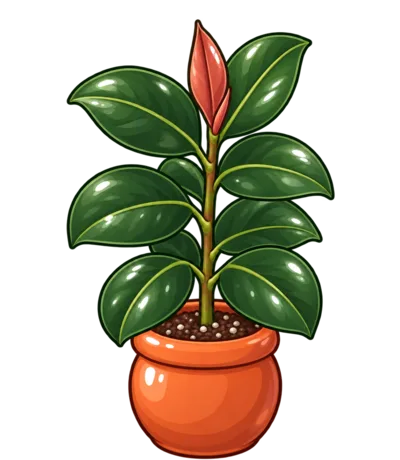
Rubber Plant (Ficus elastica) Care: Light, Watering, Propagation and Varieties
Ficus elastica · Moraceae
The rubber plant (Ficus elastica) is a classic indoor tree with big, glossy, leathery leaves. It grows straight up, is happy to stay in one spot for years and is one of the easier large houseplants to keep. Besides the dark green types, you will find colorful variegated varieties like ‘Tineke’ and ‘Red Ruby’.
How to identify a rubber plant
Ficus elastica belongs to the fig and mulberry family (Moraceae). According to Kew’s Plants of the World Online, it is native from Nepal to western Yunnan in China and western Malesia. In the wild it is a tree that, per the Missouri Botanical Garden, can reach 50–100 feet and develop banyan-like aerial roots that form extra trunks.
Indoors it typically stays between 2 and 10 feet. The leaves are oval, stiff and shiny, 12–18 inches long according to the RHS, often with bronze undersides. Each new leaf unfurls from a pink to purplish sheath (stipule) that drops off once the leaf opens. Any cut leaks a white, milky latex that was once used to make rubber, which is where the name elastica comes from.
Light
Give your rubber plant bright, filtered or indirect light, as the RHS recommends. A few hours of morning or evening sun is fine, especially in winter, but the Missouri Botanical Garden advises protecting it from afternoon sun.
Variegated varieties need more light than plain green ones. A rubber plant will survive in a dim corner, but it grows slowly, gets leggy and may drop leaves. University of Florida guidelines list low light stress as a cause of green leaf drop.
Watering
From spring to late summer, water regularly with room-temperature water and let the potting mix dry out slightly between waterings. In winter, when growth slows, keep it only just moist. Check the top layer with your finger instead of watering on a schedule.
Overwatering is the most common mistake. NC State Extension notes that too much water can cause leaf loss. Use a pot with a drainage hole and empty the saucer after watering.
Soil and repotting
The RHS suggests a loam-based potting mix with added bark for drainage. Every couple of years in spring, move the plant into a pot that is only slightly larger. For big, older plants you can skip repotting and simply replace the top layer of mix each year.
Humidity and temperature
Aim for medium to high humidity. A tray of damp pebbles or clay granules under the pot helps, as long as the pot itself isn’t sitting in water. Wipe dust off the leaves now and then with a damp cloth or sponge, as NC State Extension suggests.
Keep the plant above 50–55°F (10–13°C). For indoor plants, University of Florida guidelines consider 65–80°F (18–27°C) most appropriate. Rubber plants dislike sudden temperature swings and drafts, so avoid spots next to a frequently opened door or directly above a radiator.
Fertilizer
Feed about once a month from spring to late summer with a high-nitrogen fertilizer, which supports leafy growth. Don’t fertilize in winter.
Pruning
For a fuller plant, cut the main stem back just above a leaf in late winter or early spring. Left unpruned, a rubber plant grows into a tall, narrow column. The cut will bleed white sap, so wear gloves: the RHS warns it can irritate skin or aggravate allergies.
How to propagate a rubber plant
Rubber plants can be grown from semi-ripe cuttings in spring or summer, but the RHS recommends a heated propagator for that. A more reliable home method is air layering, where roots form on a stem while it is still attached to the parent plant. Here is the RHS method:
- In spring, pick a healthy, straight stem that is one to two years old.
- Strip the leaves and side shoots from a section about 12 inches long.
- With a sharp knife, make a 1-inch slanting cut through a leaf bud, angled toward the tip, to create a tongue.
- Pack a little moist sphagnum moss under the tongue to keep the wound open.
- Wrap the area in a 3–4 inch thick layer of moist sphagnum moss, cover it with plastic and tape both ends. Clear plastic is fine for fast rooters like Ficus.
- When strong roots are visible through the plastic, remove it and cut the stem just below the new roots.
- Pot it up, moss and all. Don’t try to pull the moss off the roots.
The RHS says rooting can take up to a year. Taking the top off the parent also acts as a pruning cut, which the Missouri Botanical Garden says encourages a bushier habit.
Variegated and colored varieties
NC State Extension lists these cultivars, among others:
- ‘Tineke’: green leaves variegated with cream or pale yellow,
- ‘Tricolor’: leaves in cream, pink and green,
- ‘Variegata’: light green leaves with white or yellow edges,
- ‘Red Ruby’ (often sold as ‘Ruby’): green leaves splashed with purple, red and white, with reddish-pink stems and ribs,
- ‘Belize’: green leaves with cream, pink and red highlights.
Non-variegated types include ‘Robusta’, which NC State calls the most common, ‘Decora’ with a pale midrib, and the very dark ‘Burgundy’. Variegated plants need a brighter spot, or their contrast fades.
Common problems
| Symptom | Cause | Fix |
|---|---|---|
| Green leaves dropping | overwatering, cold, drafts, low light | water only after the top dries, move to a steady, warm, brighter spot |
| Lowest leaf yellows and falls | normal aging | nothing, as long as new growth looks healthy |
| Brown scorched patches | direct midday or afternoon sun | pull back from the window or filter with a sheer curtain |
| Fine webbing, pale stippling | spider mites | rinse the leaves, raise humidity, see spider mites |
| White fluffy clusters in leaf joints | mealybugs | remove and treat, see mealybugs |
| Brown bumps on stems and veins | scale insects | wipe off, keep checking |
| Tall bare trunk, small leaves | not enough light | brighter spot, prune above a leaf in spring |
Toxicity
NC State Extension flags Ficus elastica as a problem for dogs, cats and horses. The ASPCA does not have a separate entry for this species, but it lists the closely related Ficus benjamina as toxic to dogs and cats, naming the enzyme ficin and psoralen (ficusin) as the toxic principles and gastrointestinal and skin irritation as the signs. The RHS warns that fig sap can irritate skin, so wear gloves when pruning or propagating. Keep the plant out of reach of pets and small children, and call your vet if an animal chews on it. See our list of houseplants toxic to cats and dogs.
Variegated & notable cultivars
- 'Tineke' — cultivar
- 'Tricolor' — cultivar
- 'Variegata' — cultivar
- 'Red Ruby' — cultivar
FAQ
Why is my rubber plant dropping leaves?
The usual causes are overwatering, a sudden drop in temperature, cold drafts or too little light. Losing the occasional lowest leaf is normal aging, as long as new leaves keep coming.
How often should I water a rubber plant?
Water regularly from spring through late summer, letting the potting mix dry out slightly between waterings. In winter, keep it only just moist. Use room-temperature water and never leave the pot sitting in water.
Is a rubber plant toxic to cats and dogs?
NC State Extension flags Ficus elastica as a problem for dogs, cats and horses. The ASPCA has no separate entry for this species but lists its relative Ficus benjamina as toxic, causing gastrointestinal and skin irritation. The milky sap can irritate skin.
How do I make my rubber plant bushier?
In late winter or early spring, cut the main stem back just above a leaf. That usually triggers side branches. Wear gloves because the white sap can irritate skin.
Does a variegated rubber plant like 'Tineke' need more light?
Yes. The RHS notes that variegated figs need more light than green ones. Give them a bright spot close to a window, but keep them out of harsh midday sun.
Sources
- NC State Extension — Ficus elastica (toxicity to dogs, cats and horses)
- POWO (Kew) — Ficus elastica
- RHS — How to grow ornamental figs
- RHS — Ficus elastica
- RHS — Air layering
- Missouri Botanical Garden — Ficus elastica
- UF/IFAS — Cultural Guidelines for Interiorscape Ficus (EP136)
- ASPCA — Fig (Ficus benjamina, related species)
Care information is general; every plant and home is different. Growing is simplified in the game.