 Rare Leaf
Pothos Varieties: How to Identify Marble Queen, N'Joy, Pearls and Jade, Manjula and More
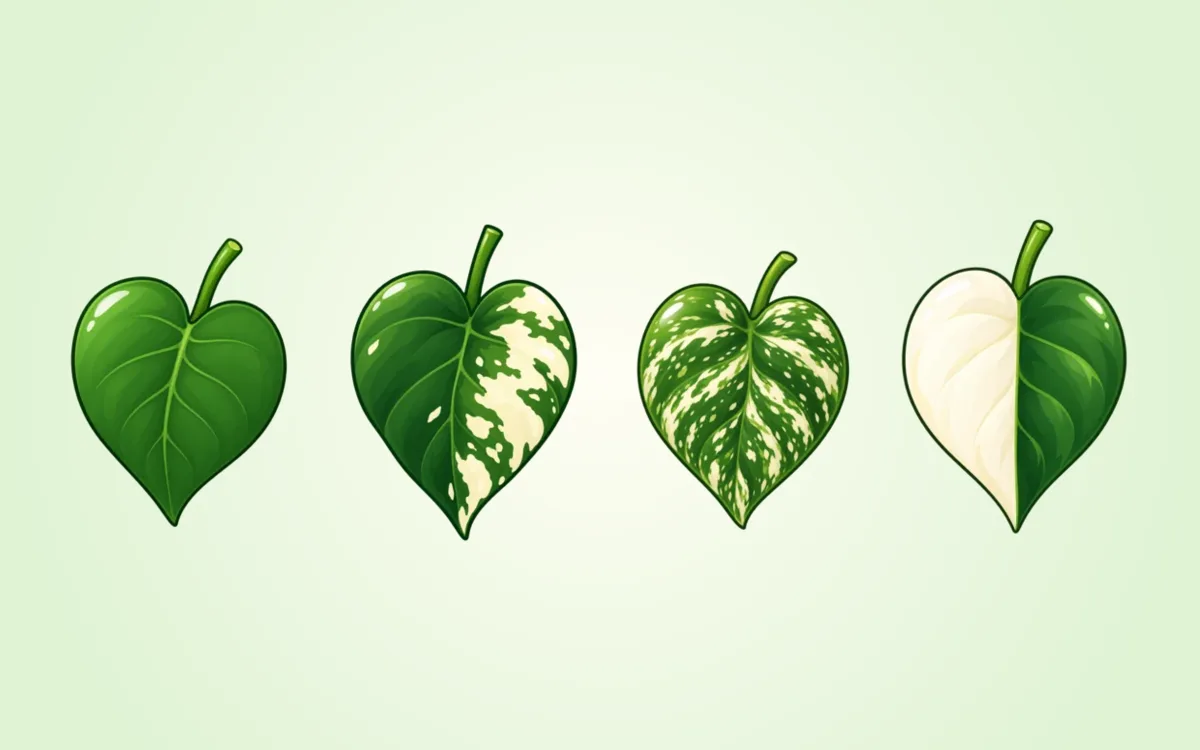
To identify a pothos variety, look at three things: the color of the variegation (yellow, white, cream, or none), its pattern (streaks, marbling, crisp patches, or tiny flecks), and the leaf itself (size, shape, and whether the surface is flat or wavy). ‘Golden’ has yellow streaks, ‘Marble Queen’ has white marbling, ‘N’Joy’ has sharp green patches on white, ‘Pearls and Jade’ has white, gray, and green flecks on a wavy leaf, and ‘Neon’ and ‘Jade’ have no variegation at all. The table below puts every variety side by side.
Pothos labels are often vague or wrong, and several varieties look almost identical in a small nursery pot. Everything here comes from extension services, university cultivar releases, and the US plant patents that describe each cultivar. A few popular names didn’t make it in because no reliable source describes them. More on that below.
Pothos varieties at a glance
| Variety | Variegation color | Pattern | Leaf | Best clue |
|---|---|---|---|---|
| ‘Golden’ | yellow and creamy white on dark green | irregular streaks, stripes, and splashes | standard heart-shaped | yellow, not white, variegation |
| ‘Marble Queen’ | white on green | marbled; stems marbled too | larger, about 12 × 8 cm (4.5 × 3 in) per UF/IFAS | white swirled through green on leaves and stems |
| ‘Snow Queen’ | white on green | heavy variegation | standard | reads whiter overall than ‘Marble Queen’ |
| ‘N’Joy’ (‘NJOY’) | green patches on cream to white | crisp, well-defined patches, often one on each side of the midrib | small, broad, ovate; smooth and waxy | clean-edged patches, very short internodes |
| ‘Pearls and Jade’ | white, gray, and green | flecks, blotches, and streaks, from dots under 1 mm to large patches | small, 7–8 × 4–5 cm; wavy, uneven surface | three colors, bumpy leaf, faintly striped vines |
| ‘Manjula’ (‘HANSOTI14’) | shades of green and yellow-green (patent description) | marbled and blotched | broad ovate to deltate, wavy, often folded upward | compact mound; light yellow-green petiole with one green stripe |
| ‘Global Green’ | yellow-green patches on olive green | two-tone, centered variegation | mid-sized, egg-shaped with a pointed tip | only greens, no white or yellow |
| ‘Neon’ | none | solid bright chartreuse | standard | uniform neon yellow-green |
| ‘Jade’ | none | solid dark green | standard | plain green, best in low light |
| ‘Cebu Blue’ | none | solid blue-green | small, narrow, lance-shaped | different species (Epipremnum pinnatum) |
Sources: NC State Extension (‘Golden’, ‘Marble Queen’, ‘Snow Queen’, ‘Neon’, ‘Jade’, ‘Cebu Blue’), UF/IFAS EP151 and EP441 (‘Golden’, ‘Marble Queen’, ‘Jade’, ‘Neon’, ‘Pearls and Jade’), and the US plant patents for ‘NJOY’, ‘UFM12’, ‘HANSOTI14’, and ‘Global Green’.
How do you tell Marble Queen from Snow Queen pothos?
This is the pair most often confused, because both have green leaves with white variegation.
- ‘Marble Queen’ has leaves and stems “marbled with white,” according to NC State Extension. UF/IFAS describes its leaves as marbled with white variegation only, with no yellow. It’s one of the four classic pothos cultivars, and several newer varieties were selected from it.
- ‘Snow Queen’ is described by NC State Extension as “highly variegated” green and white. The practical difference is the ratio: on ‘Snow Queen’, white takes up noticeably more of the leaf.
That’s where the reliable information runs out. Neither variety has a published patent or a university release describing it in detail, so there’s no measurable trait that settles it on a single leaf. Judge the whole plant, not one leaf: variegation varies from leaf to leaf on every pothos, and the difference between these two is one of degree.
How do you tell N’Joy, Pearls and Jade, and Glacier apart?
All three names turn up on small, white-variegated pothos, but only two of them are well documented.
‘N’Joy’ is registered as ‘NJOY’ (US Plant Patent 19,965) and is also sold as Beautifall® ‘Njoy’. Ashish Arvind Hansoti found it in 2002 as a branch mutation in a greenhouse near Mumbai, among selected clones of ‘Marble Queen’. The patent describes:
- small, broad, mostly ovate leaves, about 5.6 × 4.1 cm,
- a smooth, waxy upper surface,
- green patches of many shades on a cream-to-white background,
- a characteristic green patch of varying size on each side of the midrib,
- very short internodes and compact growth.
‘Pearls and Jade’ is the University of Florida cultivar ‘UFM12’ (US Plant Patent 21,217). Richard Henny and Jianjun Chen at the UF/IFAS research center in Apopka selected it as a mutation from ‘Marble Queen’ plants treated with gamma radiation. UF/IFAS and the patent describe:
- small leaves, 7–8 cm long and 4–5 cm wide,
- three colors, white, gray, and green, in irregular patches, blotches, and streaks, from specks under 1 mm to blotches covering over half the leaf,
- an irregularly wavy leaf surface rather than a smooth one,
- vines and petioles with faint, alternating gray-green stripes where they get more light.
So the quick test is this: smooth leaf with clean green patches on white means N’Joy. Wavy leaf with gray and white speckles means Pearls and Jade.
‘Glacier’ is often mentioned alongside these two, but we couldn’t find a patent, a university release, or an extension description for it. Rather than repeat unverified traits from shop listings, we’ve left it out of the table. If a plant is sold as ‘Glacier’, ask the seller where it came from.
How do you tell Manjula from Marble Queen?
Both have light variegation, but the leaf shape and the plant’s habit are different.
‘Manjula’ is the trade name of the patented cultivar ‘HANSOTI14’ (US Plant Patent 27,117). Costa Farms lists the two names together on its patents page. The same breeder found it in 2010, also near Mumbai. The patent describes:
- medium, broad ovate to broad deltate leaves, about 8.5 × 6.5 cm,
- a moderately wavy leaf that is often folded upward instead of lying flat,
- marbling and blotching in several shades of green and yellow-green,
- strong, light yellow-green petioles with a single green stripe,
- a mounding habit when young that only trails with age, and slow growth.
‘Marble Queen’ has flatter leaves, white marbling on both leaves and stems, and a longer, trailing habit. If the plant forms a tight mound and the leaves curl up at the edges, ‘Manjula’ is the better match. The patent also compares ‘Manjula’ with ‘NJOY’ and ‘Pearls and Jade’: it has larger leaves than both and a different leaf shape, a different variegation pattern than ‘NJOY’, and more variegation per leaf than ‘Pearls and Jade’.
Golden, Neon, Jade, and Global Green: the non-white pothos
‘Golden’ is the classic pothos. UF/IFAS describes dark green leaves “freely but irregularly variegated with yellow and creamy white streaks, stripes, and splashes.” The RHS calls it the most widely grown epipremnum. If the variegation is yellow rather than white, start here.
‘Neon’ has no variegation. UF/IFAS describes its leaves as bright chartreuse green. Heartleaf philodendron ‘Lemon Lime’ looks very similar, so check the petiole. Our guide on pothos vs. philodendron shows you how.
‘Jade’ is solid green. UF/IFAS calls it uniform dark green, and NC State Extension notes it does well in low light.
‘Global Green’ (US Plant Patent 33,530) was found in 2016 at a nursery in Aichi, Japan. Its patent describes two-tone leaves: yellow-green patches on each side of the midrib on an olive-green background, on mid-sized, egg-shaped leaves with a pointed tip. There’s no white or yellow in it, which sets it apart from ‘Golden’.
Is Cebu Blue a pothos?
In the plant trade, yes. Botanically, it’s a different species. NC State Extension lists ‘Cebu Blue’ under Epipremnum pinnatum and describes small, narrow, lance-shaped, blue-green leaves. Given a pole or stake to climb, the leaves mature and develop splits like the wild species. Its narrow blue-green leaf looks nothing like the heart-shaped leaf of E. aureum, so it’s easy to identify.
A note on names: the classification of pothos itself is not fully settled. The RHS lists golden pothos as Epipremnum pinnatum ‘Aureum’, and the patents for ‘NJOY’ and ‘Manjula’ also use E. pinnatum. UF/IFAS, NC State Extension, and the ‘Pearls and Jade’ and ‘Global Green’ patents use E. aureum, as does our pothos profile. For identifying varieties at home, this changes nothing.
Where do new pothos varieties come from?
Not from crossbreeding. UF/IFAS explains that pothos rarely flowers even in its native habitat and doesn’t flower in greenhouses or indoors, so no hybridized pothos cultivars are known. Every variety in this article started as a mutation. ‘NJOY’ and ‘Manjula’ appeared as natural branch mutations, ‘Global Green’ as a naturally occurring mutation, and ‘Pearls and Jade’ as a mutation induced by radiation. They’re then propagated from cuttings, which keeps the plants true to type.
Why do variegated pothos need more light?
It comes down to chlorophyll, the green pigment that captures light energy for photosynthesis. The RHS points out that all-green shoots contain more chlorophyll than variegated ones, which is why they grow more vigorously. A variegated pothos has less green surface to feed itself, so it needs the light it does get to count.
UF/IFAS describes what happens in practice. Pothos survives light as low as about 50 foot-candles, but new leaves come in small and variegated cultivars lose their color. At 150 foot-candles or more, color and leaf size hold. The RHS agrees that too little light may cause the foliage to lose its variegation and growth to be poor. ‘Pearls and Jade’ held its color during three months at 100 foot-candles in UF/IFAS trials, but that’s one cultivar in one trial.
More light doesn’t mean direct sun. UF/IFAS lists burned patches confined to the variegated areas as a sign of too much light or heat, and damaged leaves don’t recover. The RHS recommends an east- or west-facing window, or a south-facing window behind a sheer curtain.
Why does variegation revert, and what should you do?
The RHS explains that variegated cultivars are selected from a sport, or mutation, of a green plant, and those mutations aren’t always stable. A shoot can revert to solid green. Because it contains more chlorophyll, it’s more vigorous and can eventually take over the plant. Cut reverted shoots back to a leaf that still shows variegation.
UF/IFAS adds that new leaves lacking variegation can also point to low light, magnesium deficiency, or too little fertilizer. Rule those out first. The full explanation of chimeras, all-white shoots, and where to cut is in our guide to variegation reversion.
Variegation doesn’t change toxicity. The ASPCA lists golden pothos as toxic to cats and dogs because it contains insoluble calcium oxalates.
In the game
In Rare Leaf Tycoon, you grow Pothos ‘Marble Queen’. Growing is simplified and plants never die, but just like with real cuttings, you only find out whether a new leaf is green, unstable, stable, or rare once you reveal it.
FAQ
What is the difference between Marble Queen and Snow Queen pothos?
Both have green leaves with white variegation. NC State Extension describes 'Snow Queen' as highly variegated green and white, so it looks noticeably whiter overall than 'Marble Queen', whose white is marbled through the green on both leaves and stems.
How do you tell N'Joy from Pearls and Jade?
Look at the leaf surface and the colors. According to its patent, 'NJOY' has smooth, waxy leaves with crisp green patches on a cream-to-white background. 'Pearls and Jade' has wavy, uneven leaf surfaces and three colors (white, gray, and green) in small flecks, blotches, and streaks, plus faintly striped vines.
Is Manjula the same as Marble Queen?
No. 'Manjula' is the trade name of the patented cultivar 'HANSOTI14', a compact plant with broad, wavy leaves that are often folded upward. 'Marble Queen' is an older, unpatented cultivar with larger, flatter leaves and stems marbled with white.
Is Cebu Blue a pothos?
It is sold as a pothos, but NC State Extension lists 'Cebu Blue' under *Epipremnum pinnatum*, not *Epipremnum aureum*. It has small, narrow, lance-shaped, blue-green leaves with no variegation.
Which pothos variety does best in low light?
Plain green 'Jade'. NC State Extension calls it great in low light. Variegated types need more light, because UF/IFAS found that under very low light new leaves come in small and variegated cultivars lose their color.
Why is my variegated pothos turning green?
Usually too little light, or a reverted shoot. The RHS explains that all-green shoots contain more chlorophyll, grow more vigorously, and can take over, so cut them back to a leaf that still shows variegation.
Sources
- NC State Extension — Epipremnum aureum (cultivar list and descriptions)
- NC State Extension — Epipremnum pinnatum 'Cebu Blue'
- UF/IFAS EDIS — Cultural Guidelines for Commercial Production of Interiorscape Epipremnum (EP151)
- UF/IFAS EDIS — New Florida Foliage Plant Cultivar: Pothos 'Pearls and Jade' (EP441)
- US Plant Patent PP19,965 — Epipremnum plant named 'NJOY'
- US Plant Patent PP21,217 — Epipremnum plant named 'UFM12' (Pearls and Jade)
- US Plant Patent PP27,117 — Epipremnum plant named 'HANSOTI14' (Manjula)
- US Plant Patent PP33,530 — Epipremnum aureum plant named 'Global Green'
- Costa Farms — Patents (trade names matched to patented denominations)
- RHS — How to grow epipremnum
- RHS — Reversion
- ASPCA — Golden Pothos
Care information is general; every plant and home is different. Growing is simplified in the game.