 Rare Leaf
Houseplant Propagation Methods Compared: Water, Sphagnum, Perlite, LECA, Soil, Air Layering, Division
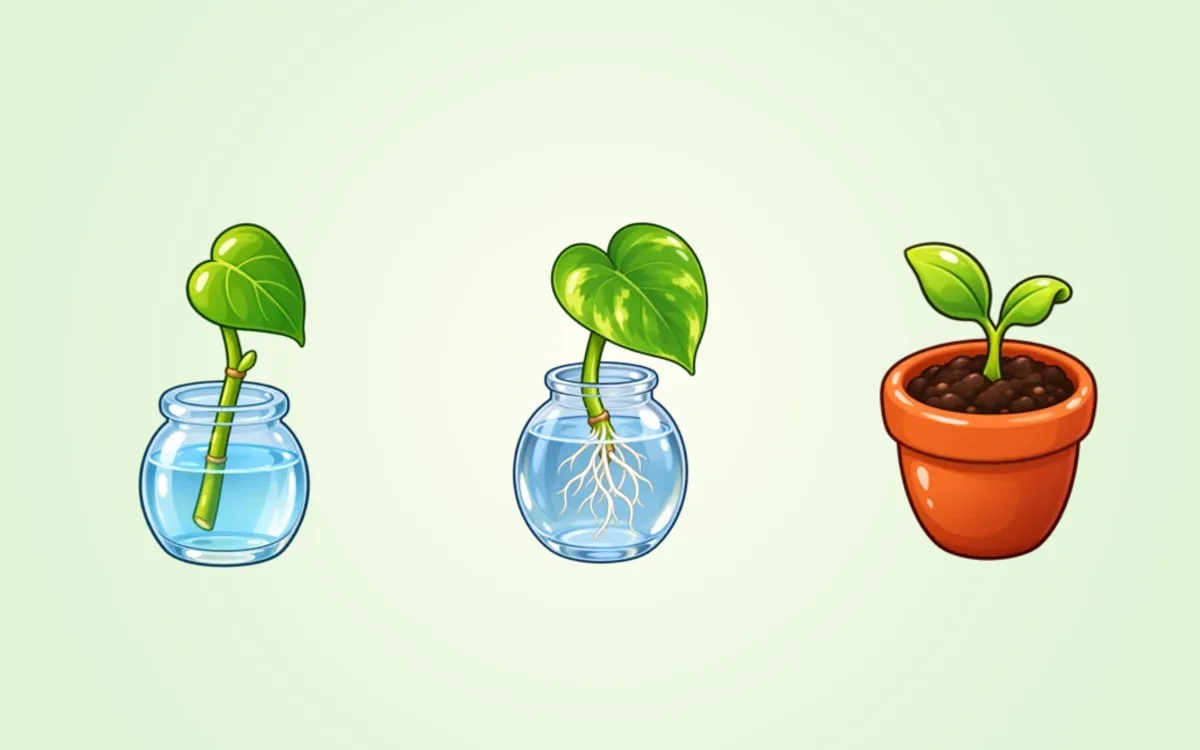
Water jar, sphagnum moss, perlite, LECA, soil, air layering or division? Every one of these works, but not for every plant and not with the same trade-offs. This guide puts all seven methods side by side, using advice from the RHS and university extension services, so you can pick the right one for the plant in front of you.
Start with the node
Whatever medium you choose, the cutting has to include a node: the spot on the stem where a leaf attaches. On aroids you’ll often see a small brown aerial root there too. University of Minnesota Extension is blunt about it for monstera: cuttings without a node and axillary bud, such as a single leaf, will not produce new growth and will eventually rot.
General rules for stem cuttings:
- Length: the RHS suggests about 3–4 inches (8–10 cm), cut just below a node. University of Illinois Extension recommends 3–6 inches with at least two nodes.
- Leaves: strip the lower leaves and keep two or three at the top (RHS).
- Timing: late spring to early summer, when the plant is actively growing. The RHS notes cuttings can work most of the year.
- Conditions: warm and bright, out of direct sun, medium kept just moist.
Propagation methods at a glance
| Method | Best for | Pros | Cons |
|---|---|---|---|
| Water | pothos, philodendron, monstera, tradescantia | you can watch roots grow, low effort | weaker roots, rot if water isn’t changed |
| Sphagnum moss | aroids, slow-rooting cuttings | holds moisture and air | dries out fast or gets soggy |
| Perlite | monstera, philodendron, most stem cuttings | airy, drains well | no nutrients, dries quickly |
| LECA | monstera and other aroids | excellent drainage, reusable | costs more, cutting must adjust later |
| Soil | almost anything | no transplant shock from water | cold, wet soil invites damping off |
| Air layering | rubber plant, philodendron, leggy monstera | cutting stays on the mother plant until rooted | takes weeks to months |
| Division | peace lily, snake plant, spider plant, prayer plant | instant rooted plants | only for plants with multiple crowns |
1. Water propagation
The classic beginner method. Put the cutting in a glass so the node is underwater and the leaves stay above it. The RHS suggests keeping the water level just below the foliage.
- Change the water when it turns cloudy (University of Minnesota Extension).
- Upside: you can see root progress, and cuttings are easy to care for and take little space.
- Downside: the same source notes water-grown roots are weaker than roots grown in a solid medium, and woody plants tend to rot in water.
N.C. Cooperative Extension recommends moving a water-rooted cutting into potting mix as soon as roots develop, before they start to rot. Pothos is the textbook example; see how to propagate pothos for a full walkthrough.
2. Sphagnum moss
Long-fiber sphagnum moss holds water while leaving air around the roots. N.C. Cooperative Extension lists sphagnum moss, perlite, vermiculite, or any combination of them as media for rooting cuttings.
How to use it:
- Soak the moss, then wring it out. Clemson HGIC recommends soaking it for several hours to saturate it fully.
- Tuck the node into the damp moss in a clear container.
- Cover the container or slip it into a clear plastic bag to keep humidity high. Vent it now and then so it doesn’t overheat.
- Aim for “wrung-out sponge,” not dripping wet.
Sphagnum is also the standard wrap for air layering (below).
3. Perlite
University of Minnesota Extension calls perlite the most common medium for monstera cuttings: it supports the cutting and gives roots both oxygen and moisture. Penn State Extension describes it as well-draining, well-aerated, and pH-neutral.
For houseplant cuttings in general, the RHS suggests a 50:50 mix of peat-free multipurpose compost and perlite. It also points out that perlite mining has an environmental cost and suggests locally sourced grit as an alternative.
4. LECA (clay balls)
LECA (lightweight expanded clay aggregate) has become a favorite with aroid growers. According to University of Minnesota Extension, its excellent drainage means you can water more often without raising the risk of damping off. It costs more than other media but can be reused.
Keep in mind that a cutting rooted in LECA still has to adjust if you later move it to soil, much like a water-rooted cutting.
5. Soil
Not as photogenic, but the most direct route: the cutting roots where it will keep growing, so there’s no switch from water to soil. N.C. Cooperative Extension recommends a sterile medium that stays moist, is firm enough to hold the cutting, and drains well.
Tips:
- Pre-moisten the mix, poke a hole, insert the cutting, and firm it in.
- Cover the pot with a clear bag or glass jar to keep humidity high around the cutting (N.C. Cooperative Extension).
- Test for roots with a gentle tug. If the cutting resists, roots are forming. Transplant once roots are about an inch long.
- Don’t overdo the water. University of Minnesota Extension warns that cold, soggy soil leads to damping off.
Penn State Extension gives 75–80°F as the ideal rooting-medium temperature. Rooting hormone can help, but the same source notes that too much slows root development.
For mature aroids, see our aroid soil mix guide.
6. Air layering
Air layering suits plants with a long, bare, or woody stem. The RHS lists Ficus and Philodendron among suitable plants. The new plant roots while still attached to the mother, which keeps supplying it with water.
Steps, based on the RHS:
- Pick a healthy, straight stem and strip side shoots and leaves from about a 12-inch section.
- Make a 1-inch cut through a leaf bud, angled toward the tip, to create a tongue. Pack a little damp sphagnum under it.
- Wrap the section with plastic, tape one end, fill the sleeve with damp sphagnum, and tape the other end.
- Check regularly. Clemson HGIC recommends checking weekly that the moss stays moist.
- When strong roots show through the moss, remove the plastic, cut just below the rooted section, and pot it up.
Timing varies. Clemson HGIC says rooting takes several weeks to months; the RHS allows up to a year for outdoor woody plants. The RHS singles out Ficus as a fast rooter where clear plastic is fine, so you can watch the roots.
For a monstera-specific version, see how to propagate monstera.
7. Division
The fastest route to full-size plants, but only for species that send up multiple shoots from the base: peace lily (Spathiphyllum), prayer plant, snake plant (Dracaena trifasciata, formerly Sansevieria), and spider plant. N.C. Cooperative Extension recommends it for prayer plants, snake plants, ferns, and African violets.
How to divide:
- Slide the plant out of its pot.
- Pull the root ball apart, or cut it. The RHS suggests an old pruning saw or kitchen knife, cutting down through the soil from top to bottom.
- Make sure each piece has both roots and shoots.
- Pot the divisions right away (Penn State Extension).
Variegated snake plants: for yellow-edged cultivars like ‘Laurentii’, division isn’t just easiest, it’s the only reliable option. Iowa State University Extension notes that leaf cuttings lose the yellow edge because the variegation is a chimera. Our variegation reversion guide explains why.
Which method should you pick?
- Vining aroids (pothos, philodendron, monstera): node cuttings in water, perlite, or sphagnum. Leggy stem? Try air layering.
- Rubber plant with a bare trunk: air layering.
- Clumping plants: divide when you repot in spring.
- Spider plant: the RHS suggests snapping off the babies from the runners and rooting them in a saucer of water or potting them straight into compost.
- Variegated plants: choose nodes that show variegation on both the leaf and the stem. See variegated houseplants for more.
Common mistakes
- No node. It may root, but it won’t grow into a plant.
- Direct sun. A cutting without roots can’t replace the water it loses.
- Soggy medium. Moss and soil should feel like a wrung-out sponge.
- Oversized pot. University of Minnesota Extension notes large containers make moisture harder to judge, which leads to overwatering.
- Impatience. The RHS says houseplant cuttings usually take 3–4 weeks to root. On monstera, a new leaf can take 2–3 months.
In the game
Rare Leaf Tycoon simplifies propagation to one step: take a cutting from a mother plant and let it grow. You only see the leaf pattern after the reveal. A stable line gives a stable pattern 76% of the time; an unstable line only 47%, but with an 8% shot at a rare leaf (versus 2% from a stable line). Unlike your windowsill, nothing in the game ever rots.
FAQ
What is the easiest way to propagate houseplants?
For vining aroids like pothos and heartleaf philodendron, a node cutting in a glass of water. For clumping plants like peace lily or snake plant, division when you repot.
Is water propagation or soil propagation better?
Both work. University of Minnesota Extension notes that roots grown in water are weaker than roots grown in a solid medium, so pot water-rooted cuttings as soon as roots form and water carefully for the first few weeks.
Why does my cutting need a node?
New roots and shoots grow from the node and its axillary bud. A leaf or petiole without a node may grow roots but will never produce a new plant, and it eventually rots.
How long does it take for houseplant cuttings to root?
The RHS says most houseplant cuttings root in about 3 to 4 weeks. Monstera cuttings root in 2 to 4 weeks, but a new leaf can take 2 to 3 months (University of Minnesota Extension). Air layers can take weeks to months.
Do I need rooting hormone?
No, but it can help. Penn State Extension notes that rooting hormone speeds up rooting, while too much of it actually slows root development.
Sources
- RHS — How to take cuttings from houseplants
- RHS — Air layering plants
- University of Minnesota Extension — Propagating Monstera deliciosa
- University of Illinois Extension — Houseplant cuttings
- Penn State Extension — Propagating Houseplants
- N.C. Cooperative Extension (Wayne County) — Propagating Houseplants
- N.C. Cooperative Extension (Richmond County) — Multiplying Your Garden for Free
- Clemson HGIC — Air Layering
- Iowa State University Extension — Caring for Sansevieria
Care information is general; every plant and home is different. Growing is simplified in the game.