 Rare Leaf
Calathea vs. Maranta (Prayer Plant): How to Tell Them Apart and How Their Care Differs
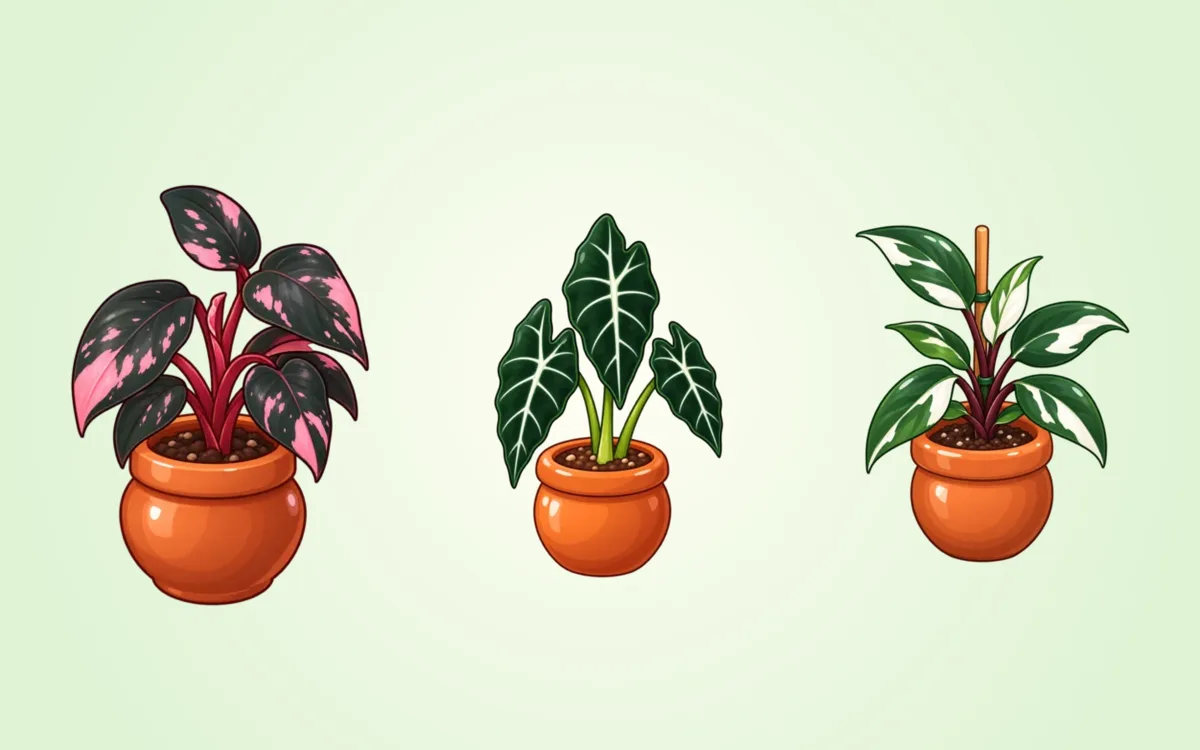
Calatheas and marantas are close relatives in the same family, Marantaceae, and both fold their leaves up at night, but they are different genera. The quickest tell is the shape of the plant: Maranta leuconeura, the true prayer plant, stays low and spreads sideways with smallish oval leaves, while the calatheas sold as houseplants (most now called Goeppertia) grow as taller, upright clumps with leaves on long stalks. Care is similar, but calatheas are usually fussier about humidity and water.
Calathea vs. maranta at a glance
| Calathea (e.g. Goeppertia orbifolia) | Prayer plant (Maranta leuconeura) | |
|---|---|---|
| Current genus | mostly Goeppertia; some sold “calatheas” are Ctenanthe or Stromanthe | Maranta (unchanged) |
| Habit | upright, clump-forming; orbifolia reaches 2–3 ft | low and spreading; 6 in to 1 ft tall |
| Leaves | orbifolia: round, up to 12 in wide, silver-green stripes | oblong to oval, up to about 8 in long; red “fishbone” veins or dark blotches |
| Night movement | many species fold leaves upward | leaves rise and fold like praying hands |
| Light | bright, out of direct sun | bright indirect light, tolerates partial to full shade |
| Water | evenly moist; rainwater or tap water left to stand 24 h | evenly moist; soft, tepid water, not hard water |
| Humidity | high; orbifolia at least 60% | high; well above 50% |
| Temperature | 61–70°F (16–21°C), no swings | 65–70°F ideal, never below 55°F |
| Propagation | division of the clump | division, basal cuttings, seed |
| Pets (ASPCA) | Calathea spp. non-toxic | “Prayer Plant” entry non-toxic (see note below) |
Sources for each row are listed at the end of the page: the RHS, NC State Extension, the New York Botanical Garden, UF/IFAS, and the ASPCA.
Is a calathea a prayer plant?
It depends on how strictly you use the name. NC State Extension calls Marantaceae “the prayer plant family,” and the RHS explains that many calatheas show the same nightly movement, with leaves that fold upward like hands in prayer. So in the loose sense, every calathea is a prayer plant.
The common name is also used for individual calatheas. NC State Extension lists “Prayer Plant” as one of the common names of Goeppertia insignis, the rattlesnake plant. That overlap causes a lot of confusion in shops and online.
In the strict sense, though, “prayer plant” means Maranta leuconeura. That’s the plant most care guides mean, and it’s the one the New York Botanical Garden and UF/IFAS describe under that name.
How to tell calathea and maranta apart
Growth habit
This is the most reliable clue, and you can see it from across the room.
- Maranta is a low, spreading plant. NC State Extension gives a height of 6 inches to 1 foot and a spread of up to 2 feet. NParks describes clumps up to about 30 cm (1 ft) tall. UF/IFAS Extension notes that it’s used in hanging baskets, where it cascades, and as groundcover in malls and other indoor plantings.
- Calatheas grow upward. The RHS describes Goeppertia orbifolia as a clump-forming, columnar, upright plant of around 75 cm, and NC State Extension gives 2–3 feet. The rattlesnake plant has what NC State calls a fountain-like form, about 1.5 feet tall indoors.
If your plant spills over the edge of the pot, it’s almost certainly a maranta. If it forms a tidy vase of leaves standing on long stalks, it’s a calathea.
Leaf shape and pattern
Maranta leaves are broadly elliptic to oval. UF/IFAS gives up to 8 inches long and about half as wide. The patterns vary by variety:
- red veins in a “fishbone” or herringbone pattern with pale markings along the midrib (NC State Extension),
- silver lines from the midrib to the edge, with deep purple or gray-green undersides (RHS),
- in var. kerchoveana, known as rabbit’s tracks, gray-green markings and conspicuous brown blotches on either side of the midrib (RHS).
Calathea leaves vary much more between species, which is part of why people collect them. Goeppertia orbifolia has large, almost round leaves up to 12 inches wide with silver-green stripes and a silvery underside (NC State Extension, RHS). The rattlesnake plant has long, narrow, wavy-edged leaves up to 18 inches long with dark green spots and purple undersides (NC State Extension).
A useful shortcut: red veins or brown “rabbit track” blotches point to maranta. Very large leaves, round leaves, or long wavy leaves point to a calathea.
Stems and roots
Both grow from rhizomes. NC State Extension describes maranta’s stems as short and rhizomatous, with long, sheathing leaf stalks. The practical difference shows up when you propagate: the RHS lists basal cuttings as well as division and seed for maranta, while its calathea guide recommends only dividing the clump.
Why calatheas are now called Goeppertia
Until 2012, these plants were classified as Calathea. That year, Borchsenius, Suárez Suárez, and Prince published a DNA study in Systematic Botany showing that Calathea in the old sense was polyphyletic, meaning it did not form one natural group. They narrowed Calathea down, resurrected the older genus Goeppertia, and made 246 new name combinations.
As a result, most calatheas on the houseplant market are now Goeppertia. The RHS lists Calathea orbifolia and Calathea rotundifolia as synonyms of Goeppertia orbifolia, and NC State Extension lists Calathea insignis and Calathea lancifolia as older names of Goeppertia insignis. The RHS also points out that plants sold under the umbrella name “calathea” now belong to three genera: Ctenanthe, Goeppertia, and Stromanthe.
Maranta leuconeura wasn’t affected. The New York Botanical Garden simply describes Maranta as closely related to Goeppertia.
Plant tags change slowly, so you’ll keep seeing “Calathea” in stores. That’s fine for shopping. When you look up care or pet safety, search both names.
Calathea vs. maranta care: what’s different?
The basics overlap: bright but indirect light, evenly moist soil, soft water, and humid air. The differences are in how much slack each plant gives you.
Light
The RHS says calatheas grow best in a bright spot out of direct sunlight, and suggests a north- or east-facing window in summer and a south-facing one in winter. NC State Extension warns that direct sun can scorch Goeppertia orbifolia.
Maranta also prefers bright, indirect light, according to NC State Extension, and direct sun fades its colors. It copes with less light, though: the RHS lists it for full or partial shade, and the New York Botanical Garden suggests a shady window or a spot behind a sheer curtain.
Water and water quality
Both want soil that stays evenly moist during the growing season and a bit drier in winter.
- Calathea: the RHS recommends keeping the compost evenly moist in spring and summer and letting the surface dry in winter, without ever letting it dry out completely. It recommends rainwater; tap water is tolerated if it stands for at least 24 hours so the chlorine evaporates. NC State Extension adds that fluoride in tap water browns the leaf tips of Goeppertia orbifolia and suggests distilled water or rainwater.
- Maranta: the New York Botanical Garden recommends tepid water, keeping the soil moist from March through September and letting the top inch dry in winter. It advises against hard water, which leaves mineral deposits on the leaves. NC State Extension notes that the leaves burn with high fluoride and with overfertilizing. UF/IFAS warns not to let water stand on the crowns, because the stems rot easily.
Humidity and temperature
Humidity is where calatheas are usually harder. NC State Extension recommends at least 60% humidity for Goeppertia orbifolia, and the RHS suggests a bathroom. For maranta, the New York Botanical Garden asks for humidity well above 50%. See our houseplant humidity guide for ways to get there.
The RHS gives 61–70°F (16–21°C) for calatheas and warns against drafts and temperature swings. For maranta, the New York Botanical Garden gives 65–70°F as ideal and a minimum of 55°F.
Feeding and propagation
The RHS recommends feeding calatheas once a month from April to September and dividing the clump in spring, making sure each piece has several leaves. For maranta, the RHS also suggests feeding monthly, and lists basal cuttings, division, and seed for propagation.
For full care guides, see our profiles of calathea orbifolia and the prayer plant.
Are calatheas and marantas safe for pets?
Both are considered non-toxic, but the paper trail is messier than it looks.
- The ASPCA lists calatheas (Calathea spp.) as non-toxic to dogs, cats, and horses. NC State Extension lists Goeppertia orbifolia and Goeppertia insignis as non-toxic to cats and dogs.
- The ASPCA’s Prayer Plant and Maranta entries are also non-toxic to dogs, cats, and horses. Both give the scientific name Calathea insignis, the rattlesnake plant, not Maranta leuconeura. So the ASPCA covers “prayer plant” by common name, and we didn’t find a separate entry for Maranta leuconeura itself.
Non-toxic doesn’t mean a pet can chew a plant without any upset stomach. Our guide to houseplants toxic to cats and dogs explains how we read the ASPCA database.
Which one should you buy?
If you want a patterned plant for a shelf, a hanging basket, or a spot away from the window, maranta is usually the easier choice. It stays small, tolerates shade, and grows from cuttings as well as division.
If you want big, dramatic leaves and can keep the air humid and use rainwater or distilled water, a calathea like Goeppertia orbifolia is the showpiece. Expect crispy brown edges if the air gets dry.
FAQ
Is a calathea a prayer plant?
Yes and no. Calatheas belong to Marantaceae, the prayer plant family, and many of them fold their leaves up at night. In the strict sense, though, "prayer plant" means Maranta leuconeura, a different genus.
What is the easiest way to tell a calathea from a maranta?
Look at the growth habit. Maranta leuconeura stays low, usually under a foot, and spreads sideways or spills over the pot. The calatheas sold as houseplants, such as Goeppertia orbifolia, grow as upright clumps with leaves held high on long stalks.
Why is my calathea labeled Goeppertia?
A 2012 DNA study showed that Calathea in its old sense was not one natural group. Most of the species grown as houseplants were moved to the resurrected genus Goeppertia, and a smaller group kept the name Calathea.
Which is easier to care for, calathea or maranta?
Both need evenly moist soil, soft water, and high humidity. The RHS lists maranta for full or partial shade, while Goeppertia orbifolia needs a humidity level of at least 60% according to NC State Extension, so maranta is usually the more forgiving of the two.
Are calatheas and marantas safe for cats and dogs?
The ASPCA lists Calathea spp. as non-toxic to dogs, cats, and horses. Its Prayer Plant and Maranta entries are also non-toxic, but they give Calathea insignis as the scientific name, not Maranta leuconeura.
Sources
- RHS — How to grow calatheas (renaming, light, water quality, humidity, temperature, division, nyctinasty)
- RHS — Goeppertia orbifolia
- RHS — Maranta leuconeura
- RHS — Maranta leuconeura var. kerchoveana
- Borchsenius, Suárez Suárez & Prince (2012): Molecular Phylogeny and Redefined Generic Limits of Calathea, Systematic Botany 37(3)
- NC State Extension — Goeppertia orbifolia
- NC State Extension — Goeppertia insignis (rattlesnake plant)
- NC State Extension — Maranta leuconeura
- New York Botanical Garden — Prayer Plant (Maranta leuconeura)
- UF/IFAS Extension Nassau County — Fact sheet: Prayer Plant
- UF/IFAS Extension Nassau County — What is a prayer plant?
- NParks Flora & Fauna Web — Maranta leuconeura
- ASPCA — Calathea
- ASPCA — Prayer Plant
- ASPCA — Maranta
Care information is general; every plant and home is different. Growing is simplified in the game.