 Rare Leaf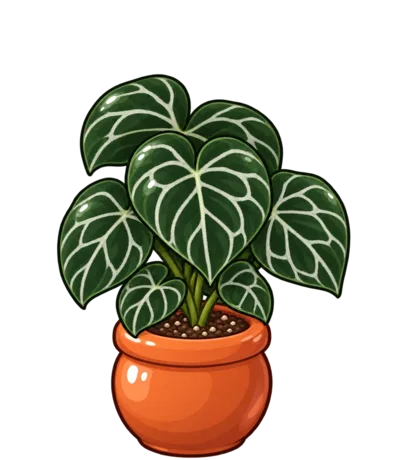
Anthurium Clarinervium Care: Light, Water, Humidity, Soil and Propagation
Anthurium clarinervium · Araceae
Heart-shaped, velvety dark green leaves with pale, almost white veins and a stiff texture that earned it the nickname “velvet cardboard.” Anthurium clarinervium is grown for its foliage rather than its flowers and is one of the most sought-after foliage anthuriums. It’s smaller than most aroids, but it needs warmth, humid air and an acidic, airy mix.
What is Anthurium clarinervium?
Anthurium clarinervium is a true species (not a cultivar) in the aroid family, Araceae. According to Kew’s Plants of the World Online (POWO), it’s native to the state of Chiapas in Mexico and grows in a seasonally dry tropical biome. The RHS and NParks also give Mexico as its origin.
How to recognize it, according to the RHS:
- Leaves: heart-shaped and deeply lobed at the base, held reflexed (bending back), velvety dark green with pale green to whitish veins, about 5 inches long.
- Size: small, about 10–12 inches tall, reaching full size in two to five years.
- Flowers: narrow, pale green spathes with a purple-flushed spadix, produced throughout the year but not the main attraction.
- Growth form: the RHS describes it as epiphytic, meaning it grows on other plants rather than in soil. Most anthuriums, the RHS notes, grow on trees in the wild, with fleshy roots clinging to mossy bark.
Unlike variegated plants, the white veining on A. clarinervium is a fixed trait of the species, not variegation.
Light requirements
The RHS recommends bright, indirect light: an east- or west-facing window, or a south-facing window shaded by a sheer curtain or thin blind. Direct summer sun scorches the leaves, and too little light slows growth. NParks lists it as a semi-shade plant.
How to water Anthurium clarinervium
Anthuriums are fussy about water. According to the RHS:
- When: water once the mix is approaching dryness. Push a finger in to check moisture about 2 inches (5 cm) below the surface.
- What: rainwater or filtered water at room temperature. In hard-water areas, tap water is alkaline, which can harm these acid-loving plants.
- How much: freely in the growing season, sparingly in winter.
- Watch out: keeping the mix too wet, or leaving the plant in waterlogged soil, causes root rot.
NC State Extension also recommends rainwater or purified water. More in our guide to watering houseplants.
Best soil mix and repotting
The mix needs to be acidic, airy and sharply draining while still holding some moisture. The RHS recommends:
- 2 parts peat-free ericaceous (acidic) potting mix,
- 1 part perlite,
- 1 part medium-grade orchid bark.
NC State Extension gives a pH below 6.0. Find more recipes in our aroid soil mix guide.
Repotting, per the RHS: a plant can usually stay in its original pot for a year or two, then repot every two to three years. Go up only one pot size, since an oversized pot stays wet too long and risks root rot.
Humidity and temperature
Temperature: the RHS recommends 65–86°F (18–30°C) year-round and, for A. clarinervium, never below 65°F (18°C). NC State Extension gives 65–85°F. Keep it out of drafts and away from radiators.
Humidity needs to be high. In dry, centrally heated homes, anthurium leaves start browning at the edges (RHS). Options that help:
- set the pot in a saucer over a larger tray of moist gravel,
- mist the leaves,
- group several plants together,
- keep it in a bathroom.
NC State Extension notes that many growers keep anthuriums in terrariums or grow cabinets. See our houseplant humidity guide.
Fertilizer
From April to October, feed with an orchid fertilizer (RHS). For A. clarinervium the RHS suggests every two weeks. Don’t feed in winter.
How to propagate Anthurium clarinervium
The RHS lists division, stem cuttings, rhizome cuttings and offsets, ideally in spring or summer. Here’s how:
Division (easiest):
- Slide a multi-stemmed plant out of its pot.
- Gently pull it apart into smaller sections, each with its own roots.
- Pot each section in an acidic, airy mix.
Stem cutting in water:
- Cut a piece of stem with leaves and aerial roots.
- Stand it in water in a warm, bright spot.
- Pot it up once roots have formed.
Stem or rhizome cutting in a propagator:
- Insert a piece of stem or rhizome into acidic, peat-free mix.
- Place it in a closed, heated propagator at 70°F (21°C).
- New roots and shoots will grow from dormant buds.
Wear gloves, as the sap is an irritant. For an overview, see our houseplant propagation guide.
Grooming and buying
Anthuriums need no pruning or training beyond removing dead leaves and spent flower stems at the base (RHS).
When buying, pick a plant with unblemished leaves and no wilting or insect damage, and keep it warm on the way home since it’s a tropical plant (RHS). Our guide to buying rare houseplants covers what else to check.
Common problems
| Symptom | Cause | Fix |
|---|---|---|
| Brown leaf edges | dry air | raise humidity: pebble tray, misting, bathroom |
| Pale scorched patches | direct summer sun | filter the light or move it back |
| Yellowing, wilting, mushy roots | overwatering, root rot | water only when nearly dry; repot into an airier mix |
| Plant declining despite careful watering | hard water, alkaline mix | switch to rainwater or filtered water; repot into an acidic mix |
| Damaged leaves after winter | cold, drafts | keep above 65°F (18°C), away from windows and doors |
| White cottony clumps in leaf joints | mealybugs | remove by hand, treat |
| Brown bumps on stalks | scale | scrape off and treat |
The RHS lists mealybugs and scale for A. clarinervium, and NC State Extension adds spider mites, whiteflies, aphids and thrips for anthuriums. See our guides to mealybugs and spider mites.
Is Anthurium clarinervium toxic to pets?
The ASPCA doesn’t list Anthurium clarinervium by name. The closest entry is “Flamingo Flower” (Anthurium scherzerianum), which is toxic to dogs, cats and horses. The toxic principle is insoluble calcium oxalate crystals. Chewing causes oral irritation, pain and swelling of the mouth, tongue and lips, excessive drooling, vomiting and difficulty swallowing.
For people, NC State Extension rates anthuriums as low severity: eating them causes drooling, mouth pain and swelling, and vomiting, and contact can irritate skin and eyes. The RHS recommends wearing gloves when handling. Keep it out of reach of children and pets, and call your vet if you suspect your pet ate some.
FAQ
Why are my Anthurium clarinervium leaves turning brown at the edges?
Usually dry air. The RHS notes that anthurium leaves start to brown at the edges in dry, centrally heated homes. A pebble tray, misting or a bathroom spot helps.
How often should I water Anthurium clarinervium?
Only when the mix is nearly dry about 2 inches (5 cm) below the surface. Use room-temperature rainwater or filtered water, since hard tap water can harm anthuriums.
What is the best soil for Anthurium clarinervium?
An acidic, airy mix. The RHS recommends two parts peat-free ericaceous potting mix, one part perlite and one part medium orchid bark.
How big does Anthurium clarinervium get?
It stays small: the RHS gives a height of about 10–12 inches and leaves around 5 inches long. It takes two to five years to reach full size.
Is Anthurium clarinervium toxic to cats and dogs?
Yes. The ASPCA lists anthuriums (entry for Anthurium scherzerianum) as toxic to dogs, cats and horses because of calcium oxalate crystals.
Sources
- ASPCA — Flamingo Flower (closest entry, genus Anthurium)
- RHS — Anthurium clarinervium
- RHS — How to grow anthuriums
- NParks Flora & Fauna Web — Anthurium clarinervium
- NC State Extension — Anthurium
- POWO (Kew) — Anthurium clarinervium
Care information is general; every plant and home is different. Growing is simplified in the game.