 Rare Leaf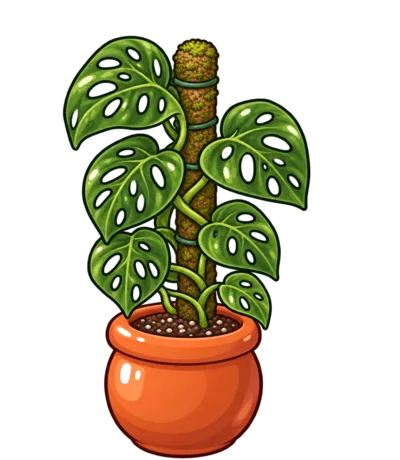
Monstera Adansonii Care: Light, Humidity, Propagation and Adansonii vs. Mini Monstera
Monstera adansonii · Araceae
Monstera adansonii is the smaller cousin of the classic Swiss cheese plant. Thin, vining stems with aerial roots carry heart-shaped leaves full of oval holes. It’s a good pick when a full-size monstera would take over the room: on a shelf, in a hanging basket or climbing a moss pole.
How to identify Monstera adansonii
It’s an evergreen climbing plant in the arum family (Araceae). Kew’s Plants of the World Online gives its native range as tropical America, from Nicaragua to Brazil and Bolivia and the Lesser Antilles, and divides the species into four subspecies. The RHS lists Monstera pertusa as a synonym.
What to look for:
- heart-shaped leaves with oval holes inside the blade, while the leaf edge usually stays intact,
- slender stems with aerial roots,
- a plant that climbs a support or trails; the RHS gives a length of about 2 m (6.5 ft),
- with support, NC State Extension says indoor plants reach roughly 3 to 8 feet tall.
In the wild it uses its aerial roots to cling to trees and climb toward the light. NC State notes that leaves can reach 18 inches wide there, though houseplants stay much smaller, and that the holes help sunlight filter down to lower leaves.
Monstera adansonii vs. deliciosa: adansonii is the smaller plant with smaller leaves. Mature Monstera deliciosa leaves are huge and split all the way to the edge.
Monstera adansonii vs. mini monstera: “mini monstera” (Rhaphidophora tetrasperma) has leaves that split in from the edge, while adansonii has holes in the middle of the leaf. Rhaphidophora isn’t a monstera at all; it just belongs to the same family.
Light requirements
NC State Extension recommends bright, indirect light and warns that direct sun scorches the leaves. An east- or west-facing window works well, or a south-facing window with a sheer curtain. The RHS notes that monsteras kept in low light produce leaves with fewer holes, and a light-starved plant also stretches out into long, sparse stems.
How often to water Monstera adansonii
NC State recommends a moist but well-drained mix. For monsteras in general, the RHS advises letting the mix become almost dry and then watering thoroughly. Both point to the same balance: the soil should never stay soggy and never go bone dry.
- Water when the top layer feels dry to the touch.
- Empty the saucer afterward. Overwatering leads to root rot.
- Water less often in winter.
- Water the soil, not the leaves. NC State notes that splashing foliage and poor air circulation encourage leaf spots.
Soil and repotting
NC State recommends a moist, well-drained, slightly acidic mix. The blend the RHS suggests for monsteras in general, 1 part peat-free ericaceous compost to 2 parts orchid mix, works well here. See aroid soil mix for more options.
Repot in spring when the roots fill the pot, and go up only slightly in size so the mix doesn’t stay wet for too long.
Humidity and temperature
This is where adansonii asks for a bit more than pothos. NC State says it prefers high humidity and recommends a humidifier or a tray of wet pebbles. Grouping plants together also helps.
For temperature, the RHS recommends 18–25 °C (65–77 °F) for monsteras. NC State advises avoiding cold drafts and drops below 50 °F (10 °C). More tips in our houseplant humidity guide.
Moss poles and pruning
NC State recommends placing a stake, trellis or moss pole in the center of the pot so the plant has something to climb. For monsteras, the RHS notes that a plant that is climbing produces larger, more mature leaves. Leggy stems can be cut back above a node, and the trimmed pieces make good cuttings.
Fertilizing
For monsteras, the RHS recommends a balanced liquid fertilizer from April to September. Don’t feed in winter.
How to propagate Monstera adansonii
NC State Extension recommends stem cuttings, and the RHS describes rooting monstera cuttings in water from spring to late summer.
- Choose a healthy stem and find a node, the point where a leaf and usually an aerial root emerge.
- Cut below the node. Each cutting should have one or two nodes and at least one leaf.
- Place it in water in bright light out of direct sun, and change the water regularly.
- Once the roots are a few centimeters (an inch or two) long, pot it up in an airy mix. Several cuttings in one pot make a fuller plant.
Wear gloves when cutting, because the sap irritates skin. For other methods, see houseplant propagation methods.
Variegated Monstera adansonii
NC State Extension lists a variegated cultivar, ‘Archipelago’. As with other variegated plants, it needs more light than the green form, but still no direct sun. For general tips, read our guide to variegated houseplants.
Common problems
| Symptom | Cause | Fix |
|---|---|---|
| Brown, crispy leaf edges | dry air | humidifier, pebble tray, group plants |
| Scorched patches | direct sun | move to indirect light |
| Leggy stems, small leaves without holes | not enough light | move closer to a window, cut back, root the cuttings |
| Yellowing, mushy stem bases | overwatering, root rot | let it dry, repot in a free-draining mix |
| Spots on leaves | water sitting on foliage, poor air flow | water at the base, improve air circulation |
| Fine webbing, tiny speckles | spider mites | see spider mites on houseplants |
| White fluffy clusters, sticky leaves | mealybugs, aphids, scale | see mealybugs on houseplants |
| Tiny white insects flying up | whiteflies | isolate the plant, rinse leaves, use yellow sticky traps |
Besides root rot and leaf spot, NC State also mentions rust, powdery mildew and blight. Keeping the leaves dry, the air moving and the soil from staying wet prevents most of them.
Is Monstera adansonii toxic?
The ASPCA doesn’t list Monstera adansonii as a separate entry. NC State Extension, however, lists it as a problem for cats, dogs and children. It contains calcium oxalate crystals, and eating it can cause inflammation of the mouth and throat, drooling, vomiting and loss of appetite. The sap irritates skin, so NC State recommends wearing gloves when handling it. Its close relative Monstera deliciosa is listed by the ASPCA as toxic to cats and dogs.
If your pet chewed the plant, call your vet. For a wider list, see houseplants toxic to cats and dogs.
FAQ
What is the difference between Monstera adansonii and Monstera deliciosa?
Monstera adansonii is a smaller, more slender plant with smaller leaves that have oval holes inside the leaf blade. Monstera deliciosa has much larger leaves that, on mature plants, are split all the way to the edge.
Does Monstera adansonii need high humidity?
It prefers it. NC State Extension recommends a humidifier or a tray of wet pebbles. In dry, heated air the leaf edges tend to turn brown.
Can Monstera adansonii grow in a hanging basket?
Yes. The RHS describes it as a plant that either climbs when given support or trails, reaching about 2 m (6.5 ft).
Is Monstera adansonii toxic to cats?
The ASPCA doesn't list this species separately, but NC State Extension lists it as a problem for cats, dogs and children because it contains calcium oxalate crystals. Treat it as toxic.
Why is my Monstera adansonii getting leggy?
Usually because it needs more light. Move it closer to a window but out of direct sun, cut back the long bare stems and root the pieces that have a node.
Sources
- NC State Extension — Monstera adansonii (not listed separately by ASPCA)
- Kew POWO — Monstera adansonii
- RHS — Monstera adansonii
- RHS — How to grow Swiss cheese plants
Care information is general; every plant and home is different. Growing is simplified in the game.