 Rare Leaf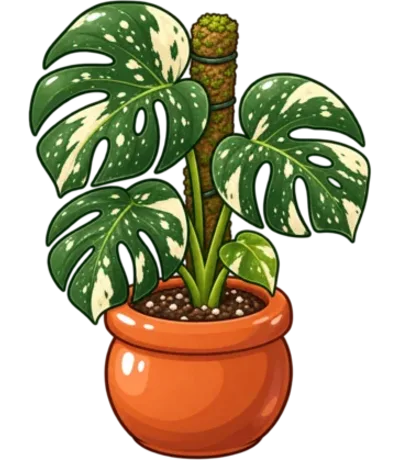
Monstera Deliciosa Care: Light, Watering, Why Leaves Don't Split, Propagation
Monstera deliciosa · Araceae
Monstera deliciosa, the Swiss cheese plant, is the classic statement houseplant: huge glossy leaves with holes and splits, rope-like aerial roots and fast growth. It’s easy to keep alive, but it needs room, something to climb and some patience before it produces those signature split leaves.
How to identify Monstera deliciosa
Monstera is an evergreen climbing vine in the arum family (Araceae). Kew’s Plants of the World Online gives its native range as Mexico (Veracruz, Oaxaca and Chiapas) to Guatemala. In the wild it starts life on the ground and climbs once it reaches a tree. Indoors it usually reaches 6 to 8 feet.
Key features:
- juvenile leaves are heart-shaped and solid, with no holes,
- mature leaves are large and leathery, with holes in the blade and slits that run to the edge,
- mature leaves have a distinct joint where the leaf stalk meets the blade,
- thick, cord-like aerial roots grow from the stem.
The holes are called fenestrations. The RHS says they’re thought to have evolved to let light through to the lower leaves. Despite the common name “split-leaf philodendron”, monstera isn’t a philodendron; the two are only relatives in the same family.
Light requirements
Give it bright, indirect light: an east- or west-facing window, or a bright room set back from a south-facing one. Direct summer sun scorches the leaves. In very low light, leaves tend to have fewer holes. Variegated forms need more light than green ones, but their white areas also burn more easily.
How often to water a monstera
NC State Extension recommends watering thoroughly and then letting the top quarter to one-third of the soil dry before the next watering. The RHS says to let the mix become almost dry. In practice: push a finger into the soil, and if it’s only damp deeper down, water.
- Never let the pot sit in a saucer of water, or the roots will rot.
- Water less often in winter.
- The RHS recommends rainwater or filtered water; hard tap water gradually makes the mix more alkaline.
Best soil for monstera and repotting
The RHS recommends an open, free-draining, slightly acidic mix (pH 5–6), ideally 1 part peat-free ericaceous compost to 2 parts orchid mix. Roots rot easily in heavy, poorly draining soil. See aroid soil mix for more options.
A young plant can stay in its nursery pot for a year or two. After that, repot every few years, ideally in spring. Go only a few centimeters (an inch or two) wider, but choose a pot heavy enough not to tip. A large monstera is top-heavy.
Moss poles and pruning
Monstera is a climber. Without support it sprawls sideways and the stems can snap. Give it a sturdy pole covered in moss or coir. Keep the pole damp and the aerial roots will grow into it.
According to the RHS, once the plant senses it is climbing, it produces larger leaves with more holes. The Missouri Botanical Garden notes that lower aerial roots can be rooted into the soil and upper ones attached to a pole or simply removed.
If the plant outgrows its space, cut it back in spring. The new shoots will carry smaller, less-split leaves for a while before it settles down.
Humidity and temperature
The RHS recommends 18–25 °C (65–77 °F) year-round; NC State Extension gives a range of 60–85 °F. Keep it away from cold drafts and radiators.
Monstera likes humid air. Dry air from central heating browns the leaf edges. A pebble tray, a humidifier or grouping plants together helps. More in our houseplant humidity guide.
Fertilizing
Feed with a balanced liquid fertilizer from April to September and not in winter. Wipe the leaves now and then with a damp cloth to remove dust so they can use light efficiently.
How to propagate monstera
Monstera is propagated from stem cuttings or by air layering. The RHS recommends taking cuttings from spring to late summer.
Stem cutting in water:
- Find a node on the stem, ideally one with an aerial root. New roots and a new shoot grow from the node.
- Cut below the node. The cutting should have a node and at least one leaf.
- Stand it in a glass of water in bright light out of direct sun. Change the water regularly.
- Once it has a good set of roots, pot it up in an airy mix (see above).
Air layering on the plant: wrap a node in damp sphagnum moss and cover it with plastic. When roots fill the moss, cut the stem below them and pot it up. The advantage is that the cutting keeps drawing on the parent plant until it has roots.
Wear gloves when cutting. A full step-by-step guide is coming in how to propagate monstera.
Variegated monstera: Thai Constellation, Albo and Variegata
- ‘Thai Constellation’: creamy white speckles and splashes across the whole leaf. The RHS describes it as slightly slower growing than the species, with more closely spaced leaves. Grower Costa Farms says it’s believed to be a naturally occurring mutation that is mostly propagated in tissue culture labs.
- ‘Albo Variegata’: bright white sectors and stripes, with every leaf different. New leaves can revert to green or come out entirely white.
- ‘Variegata’: cream-marbled leaves; it holds the RHS Award of Garden Merit.
The RHS notes that variegated forms are less widely available and usually more expensive. Costa Farms adds that variegation makes the plant weaker and slower, because the white areas have no chlorophyll. We compare the two most popular forms in Thai Constellation vs. Albo, and explain green reversion in variegation reversion.
Common problems
| Symptom | Cause | Fix |
|---|---|---|
| Small leaves with no holes | young plant, low light, no support | bright indirect light, add a moss pole, be patient |
| Brown, crispy leaf edges | dry air, radiator nearby | raise humidity, move away from heat |
| Yellowing, wilting, collapse | overwatering, poorly draining mix, root rot | let it dry, repot in a free-draining mix, empty the saucer |
| Pale scorched patches | direct midday sun | move out of direct sun |
| Plant sprawls sideways, stems crack | no support | tie it to a sturdy pole |
| Sticky residue, white fluffy clusters | mealybugs | wipe off and isolate; see mealybugs on houseplants |
| Silvery speckling, fine webbing | thrips or spider mites | see thrips and spider mites |
Is monstera toxic to pets?
The ASPCA lists Swiss cheese plant as toxic to cats and dogs. Insoluble calcium oxalates cause intense burning and irritation of the mouth, tongue and lips, drooling, vomiting and difficulty swallowing. If your pet chewed the plant, contact your vet.
For people, NC State Extension rates it as low severity and notes that the sap can irritate skin. Only the ripe fruit is edible; the RHS warns that unripe fruit can be toxic, though indoor plants very rarely fruit. See houseplants toxic to cats and dogs.
In the game
Monstera deliciosa ‘Thai Constellation’ is one of six species in Rare Leaf Tycoon. You propagate it from a mother plant, and each cutting’s pattern stays hidden until the reveal: green, unstable, stable or rare. Growing is simplified in the game, and plants never die.
Variegated & notable cultivars
- 'Thai Constellation' — tissue culture
- 'Albo Variegata' — chimera
FAQ
Why doesn't my monstera have holes in its leaves?
Young plants produce solid leaves, and the holes (fenestrations) usually appear once the plant is a few years old. Bright, indirect light and a pole to climb speed this up. In very low light, leaves tend to have fewer holes.
How often should I water a monstera?
Water thoroughly once the top quarter to third of the soil has dried out, then empty the saucer. Water less often in winter.
Should I cut the aerial roots off my monstera?
You don't have to. Lower aerial roots can be guided into the soil and upper ones attached to a moss pole. If they are in the way, you can trim them off.
Is monstera toxic to cats and dogs?
Yes. The ASPCA lists Swiss cheese plant as toxic to cats and dogs because of insoluble calcium oxalates. Chewing it causes mouth irritation, drooling and sometimes vomiting.
Can you grow a monstera from a single leaf?
No. A cutting needs a piece of stem with a node, which is where new roots and a new shoot form. A leaf with just its stalk may grow roots but will not grow into a new plant.
Sources
- ASPCA — Swiss Cheese Plant
- Kew POWO — Monstera deliciosa
- RHS — How to grow Swiss cheese plants
- NC State Extension — Monstera deliciosa
- Missouri Botanical Garden — Monstera deliciosa
- Costa Farms — Thai Constellation Monstera
Care information is general; every plant and home is different. Growing is simplified in the game.