 Rare Leaf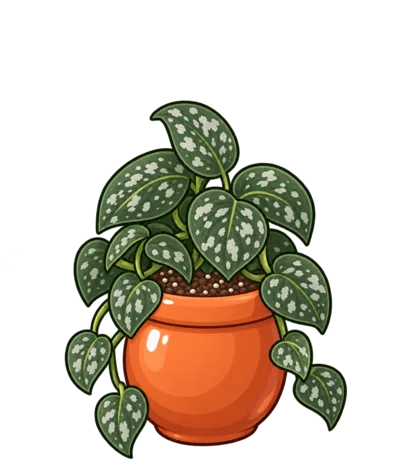
Satin Pothos Care (Scindapsus pictus): Light, Watering, Propagation, Varieties
Scindapsus pictus · Araceae
Scindapsus pictus is sold as “satin pothos” or “silk pothos”, even though it isn’t a pothos. Its matte green leaves are covered in silvery spots that shimmer like satin in the light. It grows more slowly than pothos and likes a bit more warmth, but trailing from a hanging pot or climbing a pole it is one of the prettiest vining houseplants.
How to identify satin pothos
Scindapsus pictus is an evergreen climbing plant in the arum family (Araceae). Kew’s Plants of the World Online gives its native range as southeastern Bangladesh to western and central Malesia, including Thailand, Malaysia, Sumatra, Java, Borneo, the Philippines and Sulawesi. In the wet tropics it climbs tree trunks with small aerial roots, or sprawls along the ground when there’s nothing to climb.
The species name pictus is Latin for “painted”, a nod to the leaf markings. The Missouri Botanical Garden lists Epipremnum pictum as a synonym.
Key features, according to NC State Extension and the Missouri Botanical Garden:
- juvenile leaves are oval with smooth edges and a heart-shaped base, about 3 to 4 inches long,
- the surface is matte and satiny, green to dark green, with silver-gray blotches,
- the underside is paler and has no blotches,
- mature leaves may be pinnately lobed, but houseplants are grown in the juvenile form,
- indoor plants rarely flower or fruit.
Indoors, the Missouri Botanical Garden says it typically reaches 18 to 36 inches when trained on a support. It can just as easily trail from a hanging basket.
Satin pothos vs. pothos: true pothos (Epipremnum aureum) has glossy leaves variegated with yellow or white and belongs to a different genus. Adding to the confusion, pothos itself was once sold as Scindapsus aureus.
Light requirements
Both institutions recommend bright, indirect light and warn against direct sun. An east- or west-facing window is ideal, or a spot set back from a south-facing one. In low light, the already slow growth slows further and the vines get sparse. See our houseplant light guide.
How often to water satin pothos
The Missouri Botanical Garden recommends keeping the soil consistently moist during the growing season and cutting back in winter. NC State recommends a moist but well-drained mix. The “well-drained” part matters: NC State warns that root rot can develop in poorly drained or wet soil.
How to read watering mistakes, per NC State:
- yellow leaves may be a sign of overwatering,
- curling leaves may be a sign of underwatering.
More in how to water houseplants.
Soil and repotting
The Missouri Botanical Garden suggests a peaty potting mix; NC State recommends one that is acidic, rich in organic matter and well-drained. In practice, a houseplant mix lightened with bark and perlite, or an aroid mix, works well (see aroid soil mix).
Because it grows slowly, it doesn’t need frequent repotting. Repot in spring once the roots fill the pot, and go up only one size.
Temperature and humidity
Temperature matters more for Scindapsus than for pothos. The Missouri Botanical Garden recommends 65–85 °F (18–29 °C) and advises avoiding temperatures below 60 °F (16 °C), because cooler air may damage the leaves. NC State adds that it doesn’t tolerate cool air or direct sun. A drafty winter windowsill is not a good spot.
The sources we used don’t give a specific humidity target. Since it comes from the wet tropics, grouping it with other plants in a dry, heated home won’t hurt. More in houseplant humidity.
Fertilizing
The Missouri Botanical Garden recommends feeding monthly during the growing season and cutting back in winter. A general houseplant fertilizer is fine.
How to propagate Scindapsus pictus
Satin pothos is propagated from stem cuttings. The Missouri Botanical Garden recommends 4-inch cuttings taken in spring or early summer.
- Choose a healthy vine and take a piece about 4 inches long with at least one node, the point where a leaf joins the stem.
- Cut just below the node. You can remove the lowest leaf so the node can sit in water or soil.
- Root it in water or in a moist, airy mix, somewhere warm and bright but out of direct sun.
- Once rooted, plant several cuttings in one pot. Since it grows slowly, extra cuttings give you a full look much faster than waiting.
Pinching back the stem tips keeps the plant tidy, and the pinched tips can go straight into water as cuttings. Wear gloves while you work.
Satin pothos varieties
In Scindapsus, the silver pattern is a trait of the species itself, which is where the name pictus comes from. Cultivars differ in leaf size and how much silver they show. NC State lists:
- ‘Argyraeus’: small, dark green leaves with silver edges,
- ‘Exotica’: heart-shaped green leaves splashed with shimmery silver,
- ‘Silvery Ann’ (also ‘Silvery Anne’): larger, lance-shaped, light green leaves with big silver splotches,
- Shimmering Falls™ Silver Splash: dark green leaves with silver mottling.
We explain how natural leaf patterns differ from variegation in variegated houseplants.
Common problems
| Symptom | Cause | Fix |
|---|---|---|
| Curling leaves | underwatering | water thoroughly, check soil moisture more often |
| Yellow leaves | overwatering | let the mix dry a little, check drainage |
| Mushy roots, wilting in wet soil | poorly draining mix, root rot | repot in an airy mix |
| Damaged leaves after a cold spell | temperatures below 60 °F, cold drafts | move somewhere warmer, away from the window |
| Scorched patches | direct sun | move to indirect light |
| Leaf spots, gray fuzzy mold | fungal leaf spot, botrytis | remove affected leaves, keep foliage dry, improve air flow |
| Silvery streaks, distorted new leaves | thrips | see thrips on houseplants |
| White fluff, brown bumps, webbing | mealybugs, scale, mites | see mealybugs and spider mites |
Is satin pothos toxic?
The ASPCA lists satin pothos (Scindapsus pictus) as toxic to cats, dogs and horses. It contains insoluble calcium oxalates. Signs include oral irritation, pain and swelling of the mouth, tongue and lips, excessive drooling, vomiting and difficulty swallowing. If you think your pet has chewed on it, call your vet.
Keep it out of reach of children and pets, and wear gloves when pruning. See houseplants toxic to cats and dogs for more.
Variegated & notable cultivars
- 'Argyraeus' — natural pattern
- 'Exotica' — natural pattern
- 'Silvery Ann' — natural pattern
FAQ
Is satin pothos a real pothos?
No. "Satin pothos" is a trade name. Scindapsus pictus belongs to the genus Scindapsus, while pothos is Epipremnum aureum. Both are related members of the arum family.
Why are my satin pothos leaves curling?
NC State Extension notes that curling leaves may be a sign of underwatering. Water thoroughly and don't let the mix dry out completely during the growing season.
Why is my Scindapsus growing so slowly?
It's naturally slow; both the Missouri Botanical Garden and NC State Extension describe it as a slow grower. Bright indirect light, warmth and monthly feeding in the growing season help.
What temperature does satin pothos need?
The Missouri Botanical Garden recommends 65–85 °F (18–29 °C) and advises avoiding temperatures below 60 °F (16 °C), as cooler air can damage the leaves.
Is satin pothos toxic to cats?
Yes. The ASPCA lists satin pothos (Scindapsus pictus) as toxic to cats, dogs and horses because of insoluble calcium oxalates.
What is the difference between Scindapsus Argyraeus and Exotica?
According to NC State Extension, Argyraeus has small, dark green leaves with silver edges, while Exotica has heart-shaped green leaves splashed with larger areas of shimmery silver.
Sources
- ASPCA — Satin Pothos
- Kew POWO — Scindapsus pictus
- NC State Extension — Scindapsus pictus
- Missouri Botanical Garden — Scindapsus pictus 'Argyraeus'
Care information is general; every plant and home is different. Growing is simplified in the game.