 Rare Leaf
Scindapsus vs. Pothos: Is Satin Pothos a Real Pothos? How to Tell Them Apart
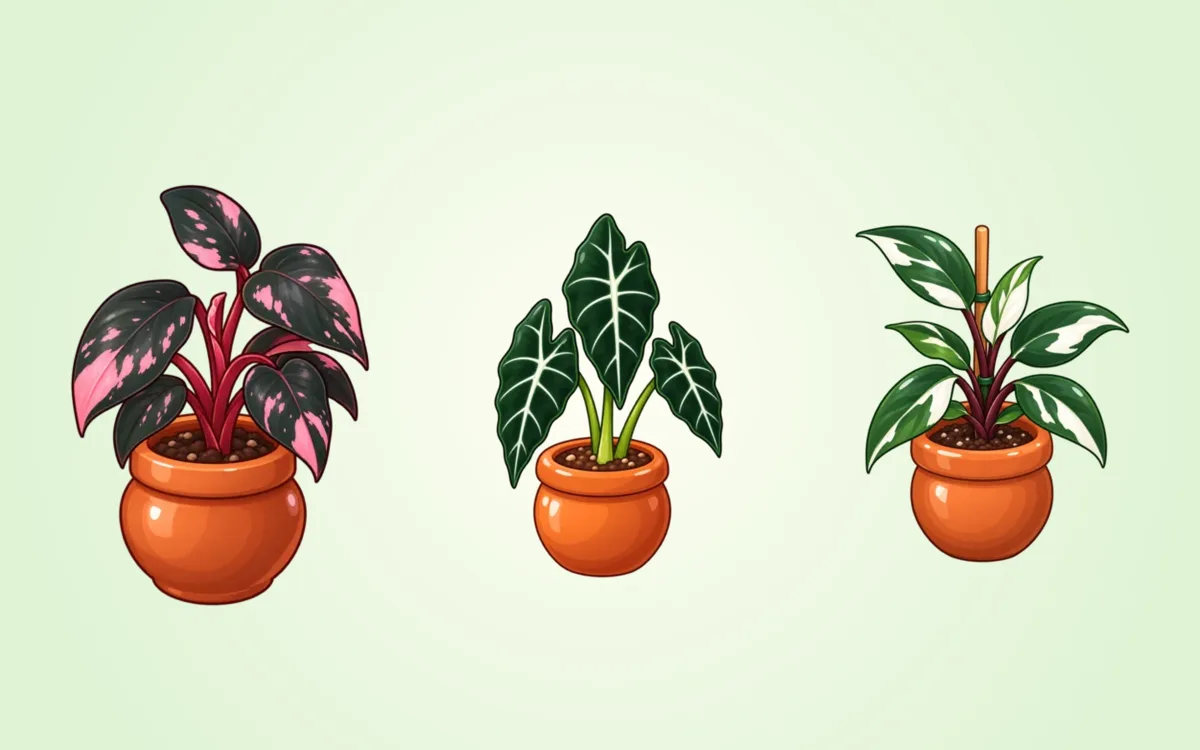
Satin pothos is not a true pothos. Scindapsus pictus belongs to the genus Scindapsus, while pothos is Epipremnum aureum, in the genus Epipremnum. The quickest way to tell them apart is the leaf: Scindapsus has matte, satiny leaves with silver spots, while pothos has glossy leaves that are either solid green or variegated with yellow, cream, or white.
Both are climbing aroids in the arum family (Araceae), they sit side by side at the garden center, and they’re often sold under similar names. That’s why people mix them up. Their care is similar but not identical: Scindapsus grows more slowly, wants more light, and handles cold worse.
Scindapsus vs. pothos at a glance
| Satin pothos (Scindapsus pictus) | Pothos (Epipremnum aureum) | |
|---|---|---|
| Genus | Scindapsus | Epipremnum |
| Leaf surface | matte, smooth, satiny | glossy, leathery |
| Markings | silver-gray blotches or edges; underside unmarked | green, or variegated with yellow, cream, or white in cultivars |
| Growth rate | slow | medium |
| Habit | climbing or trailing vine | climbing or trailing vine; climbs by brown aerial roots |
| Light | bright, indirect; no direct sun | bright, indirect is best; survives long periods in low light |
| Watering | keep consistently moist in the growing season | let the mix dry out between waterings |
| Propagation | stem cuttings | stem cuttings; roots easily in water |
| Pet toxicity (ASPCA) | toxic to cats, dogs, and horses | toxic to cats and dogs |
The table draws on NC State Extension, the Missouri Botanical Garden, the RHS, and the ASPCA (see sources below).
Is satin pothos a pothos?
Botanically, no. “Satin pothos,” also sold as silk pothos or silver pothos, is a trade name for Scindapsus pictus. NC State Extension places it in the genus Scindapsus and lists Pothos argyraeus and Scindapsus argyraeus as synonyms. The Missouri Botanical Garden adds Epipremnum pictum as another synonym.
The name confusion runs the other way too. The University of Florida notes that pothos was previously classified as Pothos aureus, Scindapsus aureus, and Raphidophora aurea before being placed in Epipremnum. The RHS points out that epipremnums are still sometimes sold under their old name, Scindapsus. So if a label says “Scindapsus,” check the leaves. The tag alone doesn’t settle it.
The two plants are related, share a family, and grow in a similar way. They’re simply different genera, and that shows up in their care.
How to tell Scindapsus from pothos by the leaves
Leaf texture and shape
NC State Extension describes the juvenile leaves of Scindapsus pictus as oval, with smooth edges and a heart-shaped base, about 3–6 inches long, with a smooth, satiny texture. The green is matte, from medium to dark.
Pothos leaves, per the same source, are heart-shaped to elliptic-ovate, glossy and leathery, with a paler underside. Shine is the most reliable clue: pothos reflects light like a polished surface, while Scindapsus has a soft shimmer, almost as if it’s dusted.
Silver markings vs. variegation
This is the key difference. The silver-gray blotches on Scindapsus pictus are a natural pattern of the species. The Missouri Botanical Garden explains that the species name pictus is Latin for “painted,” a reference to the leaf coloring. NC State adds that the underside is paler and has no blotches.
Pothos is green at its base, and its colored cultivars are variegated: parts of the leaf are yellow, cream, or white. The University of Florida names the main cultivars as ‘Golden Pothos’ (yellow variegation), ‘Jade Pothos’ (solid green), and ‘Marble Queen’ (white variegation). NC State also lists ‘Neon’, with yellow leaves.
In practice:
- silvery, metallic spots or edges on a matte leaf point to Scindapsus,
- yellow, cream, or white streaks and marbling on a glossy leaf point to pothos,
- a solid green, glossy leaf with no markings is most likely a green pothos such as ‘Jade’, not a Scindapsus.
For more on the difference between natural leaf patterns and true variegation, see our guide to variegated houseplants.
Satin pothos varieties
NC State Extension describes these Scindapsus pictus cultivars:
- ‘Argyraeus’: small, dark green leaves with silver edges,
- ‘Exotica’: heart-shaped green leaves splashed with shimmery silver,
- ‘Silvery Ann’ (also ‘Silvery Anne’): large, lance-shaped, light green leaves with big silver splotches.
The Missouri Botanical Garden notes that argyraeus means “silvery.”
Which grows faster, Scindapsus or pothos?
Pothos, by a clear margin. Both the Missouri Botanical Garden and NC State Extension describe Scindapsus pictus as a slow-growing vine. In the wild, it climbs tree trunks with small rootlets, and without support it sprawls along the ground.
NC State rates pothos as a medium-rate grower. It climbs by brown aerial roots, and its trailing vines can get very long. If you want to fill a shelf or a hanging basket quickly, pothos will get there first. Scindapsus rewards patience.
Indoors, both are grown in their juvenile form, and NC State notes that neither flowers often as a houseplant.
Satin pothos vs. pothos care
Light
For Scindapsus pictus, both NC State and the Missouri Botanical Garden recommend bright, indirect light and warn against direct sun.
Pothos is more forgiving. NC State says it prefers bright, indirect light but survives for long periods in low light. The RHS says it can tolerate some shade, though low light slows growth and makes variegated forms lose their markings. For a dimmer corner, pothos is the better pick.
Watering
Here the two go in opposite directions:
- Scindapsus: the Missouri Botanical Garden recommends keeping the soil consistently moist during the growing season and watering less in winter. NC State recommends a moist but well-drained mix and warns that roots can rot in poorly drained soil. Yellow leaves may signal overwatering; curling leaves may signal underwatering.
- Pothos: NC State says to let the potting mix dry out between waterings. The RHS recommends watering only once the compost is approaching dryness, because overwatering is the main risk and the roots rot easily.
On a satin pothos, curling leaves are a handy cue that it’s time to water.
Temperature
Scindapsus is more sensitive to cold. The Missouri Botanical Garden recommends 65–85 °F (18–29 °C) and advises avoiding temperatures below 60 °F (16 °C), since cooler air may damage the leaves. NC State adds that it doesn’t tolerate cool air.
For pothos, the RHS gives 65–86 °F (18–30 °C) and advises keeping it away from cold drafts and direct heat from radiators.
Soil and fertilizer
For Scindapsus, the Missouri Botanical Garden suggests a peaty potting mix, and NC State recommends one that is acidic, rich in organic matter, and well-drained. The Missouri Botanical Garden recommends feeding monthly in the growing season and less in winter. For pothos, NC State simply calls for a well-drained potting medium.
Do you propagate them the same way?
Mostly, yes. Both are propagated from stem cuttings. The difference is speed.
- Pothos: the RHS calls it very easy to propagate, either by rooting cuttings in water or by pinning a trailing stem onto potting mix until it roots. NC State confirms the vines root easily in water. The University of Florida describes short commercial cuttings with a node and a leaf that root in about 3–4 weeks.
- Scindapsus: the Missouri Botanical Garden recommends 4-inch stem cuttings taken in spring or early summer. Because the plant grows slowly, planting several rooted cuttings in one pot gives you a fuller look much sooner.
For step-by-step instructions, see how to propagate pothos. The same method works for Scindapsus; just expect everything to take longer.
Are satin pothos and pothos toxic to pets?
Yes, both are. The ASPCA lists satin pothos (Scindapsus pictus) as toxic to cats, dogs, and horses, and golden pothos (Epipremnum aureum) as toxic to cats and dogs. In both plants the cause is insoluble calcium oxalates. The signs are similar: oral irritation, pain and swelling of the mouth, tongue, and lips, excessive drooling, vomiting, and difficulty swallowing. If you think your pet has chewed on either plant, call your vet.
The RHS advises wearing gloves when handling pothos and keeping it away from children and pets. NC State lists pothos as toxic to people as well.
Which should you choose?
- Pothos is the better choice if your light is limited, you sometimes forget to water, and you want quick results.
- Scindapsus suits a bright spot out of direct sun in a warm home, and anyone who loves silver foliage and doesn’t mind slower growth.
For full care profiles, see our plant pages for Scindapsus pictus and Epipremnum aureum.
In the game
Rare Leaf Tycoon features Pothos ‘Marble Queen’. You propagate cuttings from a mother plant on a stable or unstable line, and you only find out the leaf pattern after the reveal: green, unstable, stable, or rare. Growing is simplified in the game, and plants never die.
FAQ
Is satin pothos a pothos?
No. Satin pothos is Scindapsus pictus, in the genus Scindapsus, while pothos is Epipremnum aureum, in the genus Epipremnum. They are related members of the arum family (Araceae), but they are different genera.
How can I tell Scindapsus from pothos?
Look at the leaf surface and the markings. Scindapsus pictus has matte, satiny leaves with silver-gray blotches; pothos has glossy, leathery leaves that are solid green or variegated with yellow, cream, or white.
Why was pothos once called Scindapsus?
According to the University of Florida, pothos was previously classified as Pothos aureus, Scindapsus aureus, and Raphidophora aurea. The RHS notes it is still sometimes sold under the old name Scindapsus.
Does satin pothos grow faster than pothos?
No, it grows more slowly. NC State Extension rates pothos as a medium-rate grower, while both NC State and the Missouri Botanical Garden describe Scindapsus pictus as slow-growing.
Can satin pothos handle low light like pothos?
Not as well. NC State says pothos survives for long periods in low light, while the sources we checked recommend bright, indirect light for Scindapsus pictus and do not describe it as shade tolerant.
Is satin pothos toxic to cats and dogs?
Yes. The ASPCA lists satin pothos as toxic to cats, dogs, and horses, and golden pothos as toxic to cats and dogs. Both contain insoluble calcium oxalates.
Sources
- NC State Extension — Scindapsus pictus
- NC State Extension — Epipremnum aureum
- Missouri Botanical Garden Plant Finder — Scindapsus pictus 'Argyraeus'
- RHS — How to grow epipremnum
- UF/IFAS EDIS — Cultural Guidelines for Interiorscape Epipremnum (EP151)
- ASPCA — Satin Pothos
- ASPCA — Golden Pothos
Care information is general; every plant and home is different. Growing is simplified in the game.