 Rare Leaf
How to Propagate Pothos in Water or Soil: Step-by-Step Guide
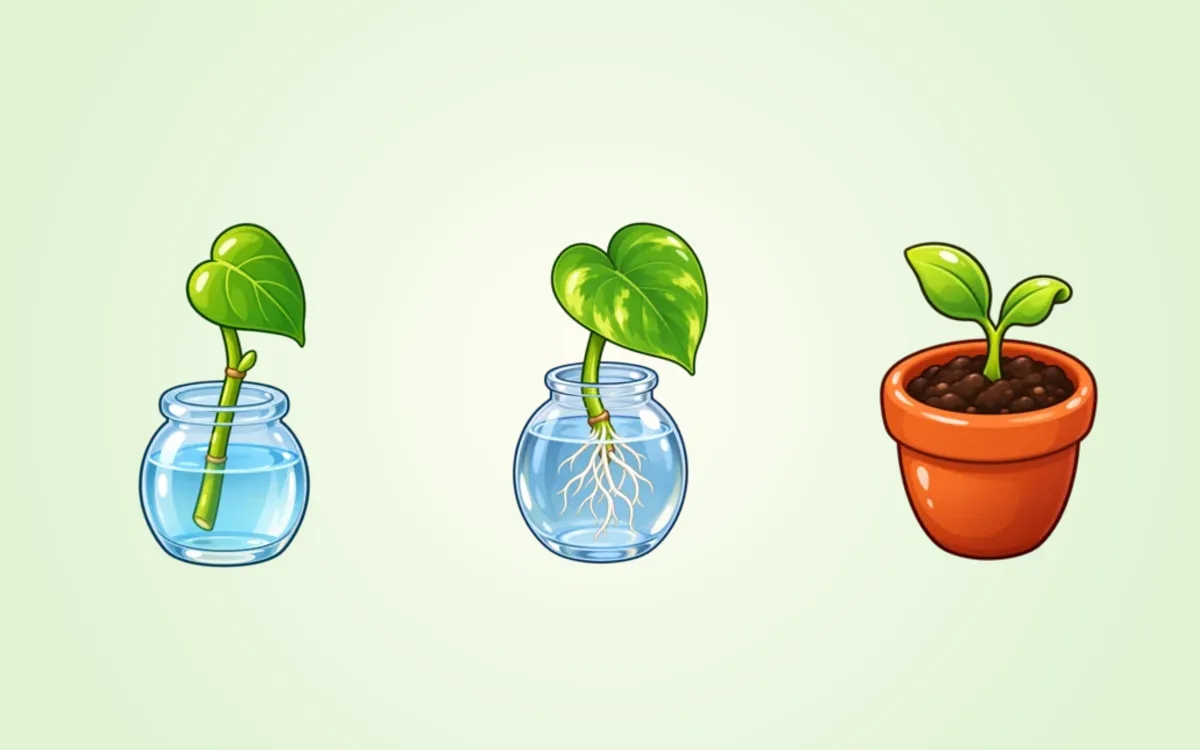
Pothos (Epipremnum aureum, also called devil’s ivy) is about the easiest houseplant there is to propagate. NC State Extension notes that the vines root easily in water, and the Missouri Botanical Garden calls it easily propagated from stem cuttings. One healthy plant can become ten. With variegated varieties like ‘Marble Queen’ or ‘Njoy’, you can even choose what the new plants’ leaves will look like.
Here’s how to do it, whether you root in water or straight in soil.
What you’ll need
- a healthy mother plant,
- clean, sharp scissors or pruners,
- a glass or jar of room-temperature water (clear is best, so you can see the roots), or a small pot with a light, well-draining potting mix,
- a warm spot with bright, indirect light.
Step 1: Find the node
A node is the slightly raised bump on the stem where a leaf attaches. On pothos you’ll often see a small brown nub there. That’s an aerial root. New roots and the new vine grow from the node.
This is the one rule you can’t skip. No node, no new plant. A leaf with just its stalk may sit in water for months and even grow roots, but it will never produce a new vine.
Step 2: Take the cutting
Cut the stem just below a node. The University of Vermont Extension suggests a 3–6 inch tip cutting with several nodes. Commercial growers in Florida use cuttings as short as 1–1½ inches, each with a single node and one leaf. Both approaches work.
A good home cutting has:
- one to three leaves,
- one or two nodes,
- no rot, pests, or damaged stem.
A long, leggy vine can be cut into several pieces, as long as each piece has a node. Cutting back leggy vines also makes the mother plant bushier. The Missouri Botanical Garden recommends pinching stems to shape anyway.
Choosing cuttings from variegated pothos
With ‘Marble Queen’, ‘Njoy’, and other variegated varieties, look at the stem around the node, not just the leaf. Choose nodes where both the leaf and the stem show variegation. A purely green node will very likely grow into a green plant. The RHS explains that all-green shoots on variegated plants are more vigorous and can take over, which is why it’s worth selecting carefully. (More on this in our guide to variegated houseplants.)
Step 3: Water or soil?
In water: remove any leaf that would sit below the waterline, then put the cutting in the glass so the node is underwater and the leaves stay above it. UVM Extension says to replace the water with fresh, room-temperature water whenever it turns cloudy. Once a week is a sensible routine. The big advantage: you can watch the roots grow.
In soil: push the node into a pot of moist, airy potting mix (a standard houseplant mix with some perlite works well) and firm it gently. Keep it lightly moist, never soggy. The advantage: the cutting doesn’t have to adjust from water to soil later.
Both methods work. For a first attempt, water is more fun and makes it easy to see what’s happening. If you have several cuttings, try both and compare.
Step 4: Wait for roots
How long pothos cuttings take to root depends mostly on warmth and light. UVM Extension puts it honestly: it can take days, weeks, or sometimes months. In Florida’s commercial production (warm shadehouses around 70–90°F), UF/IFAS reports buds breaking in 2–3 weeks and rooting in 3–4 weeks. In a cool apartment in winter, expect it to take longer.
While you wait:
- keep the cutting out of direct sun, especially in water, which can overheat in a sunny window,
- don’t keep pulling the cutting out to check,
- top up or change the water when it gets low or cloudy.
Step 5: Pot up the rooted cutting
Once the roots are about 2–3 inches long, move the cutting into a small pot with potting mix. That’s the length UVM Extension recommends. Planting several cuttings in one pot gives you a fuller plant much faster than a single vine.
For the first few weeks, water carefully. Roots that grew in water have to adjust to soil, so keep the mix lightly moist rather than letting it dry out completely. After that, switch to normal pothos care. The RHS recommends letting the top 2 cm (about 1 inch) of the mix dry out between waterings and cutting back on water in winter to avoid root rot. Our watering guide and repotting guide cover the details.
Light and variegation after propagation
Pothos tolerates low light, but variegated types pay for it. In UF/IFAS research, pothos kept in very dim interiors produced smaller leaves, and variegated cultivars lost color. Brighter indirect light kept their color and leaf size. The RHS adds that deep shade reduces variegation, while direct summer sun can scorch the leaves. For young plants from variegated cuttings, a bright spot out of direct sun is the best way to keep the pattern you selected for.
Common mistakes
| Mistake | What happens | Fix |
|---|---|---|
| Cutting without a node | Leaf may root but never grows a vine | Always include at least one node |
| Leaves below the waterline | Submerged leaves rot and foul the water | Strip leaves that would sit underwater |
| Jar in direct sun | Water overheats, cutting stresses | Bright, indirect light only |
| Old, cloudy water | Stem starts to rot | Replace water when it clouds, about weekly |
| Green node from a variegated plant | New plant grows plain green | Pick nodes with variegation on leaf and stem |
| Potting up too early | Tiny roots struggle in soil | Wait until roots are about 2–3 inches |
| Soggy soil after potting | Root rot | Keep mix lightly moist, never waterlogged |
Is pothos toxic to pets?
Yes. The ASPCA lists golden pothos as toxic to cats and dogs. It contains insoluble calcium oxalates that cause mouth irritation, drooling, vomiting, and difficulty swallowing. Keep jars of cuttings where curious pets can’t reach them. See our list of houseplants toxic to cats and dogs.
More on propagation
If you want to try other plants, our overview of houseplant propagation methods covers stem cuttings, air layering, and division, and how to propagate Monstera applies the same node rules to a much bigger plant. For everything else about this plant, see our pothos plant profile.
In the game
Every new leaf on a variegated cutting is a small surprise, and Rare Leaf Tycoon is built around that feeling. Cuttings from your mother plant go through the stages cutting → roots → new leaf, and only then do you see their pattern. A stable line gives you a reliable result, and an unstable line gives you a better shot at a rare half-moon leaf. Real propagation teaches patience. The game compresses it into a few hours, so you can see what happens if you keep taking cuttings from the same mother again and again.
FAQ
Can you propagate pothos from just a leaf?
No. A leaf without a piece of stem and a node may grow roots in water, but it will not produce a new vine. Every cutting needs at least one node, the bump where the leaf meets the stem.
How long does it take pothos cuttings to root?
It varies with warmth and light. In commercial production, UF/IFAS reports buds breaking in 2–3 weeks and roots in 3–4 weeks. In a cool room it can take longer. Pot up once the roots are about 2–3 inches long.
Is it better to propagate pothos in water or soil?
Both work. Water lets you watch roots form and is forgiving for beginners. Rooting straight in soil means the cutting does not have to adjust from water roots to potting mix later. Warmth and bright, indirect light matter more than the method.
Why is my variegated pothos cutting growing all green?
Most likely the node you cut was green. With variegated varieties such as Marble Queen, choose nodes that show variegation on both the leaf and the stem.
Where do you cut pothos to propagate?
Cut just below a node, so each piece has one to three leaves and at least one node. A long vine can be cut into several pieces, as long as each one has a node.
Sources
- UF/IFAS EDIS — Cultural Guidelines for Commercial Production of Interiorscape Epipremnum (EP151)
- University of Vermont Extension — More, Please: Propagating Houseplants
- NC State Extension — Epipremnum aureum
- Missouri Botanical Garden Plant Finder — Epipremnum aureum
- RHS — Epipremnum
- RHS — Reversion in plants
- ASPCA — Golden Pothos
Care information is general; every plant and home is different. Growing is simplified in the game.