 Rare Leaf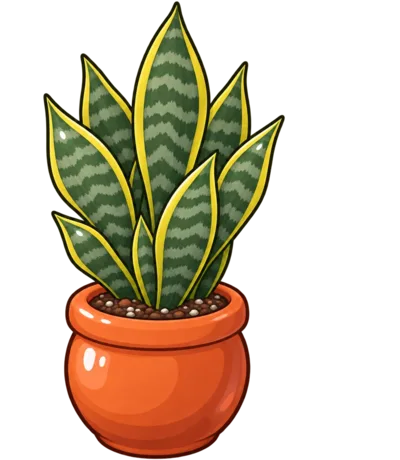
Snake Plant Care (Dracaena trifasciata, formerly Sansevieria): Watering, Light, Propagation
Dracaena trifasciata · Asparagaceae
The snake plant (Dracaena trifasciata, formerly Sansevieria trifasciata), also called mother-in-law’s tongue, is a succulent houseplant with stiff, upright, sword-shaped leaves. It tolerates drought, low light and forgetful owners, which is why it tops nearly every list of easy houseplants. What usually kills a snake plant is overwatering, not neglect.
How to identify a snake plant
The leaves grow in a rosette straight from an underground rhizome, with no visible stem. NC State Extension describes them as flat, stiff and succulent, up to 4 feet long and 2–4 inches wide, with crosswise bands in different shades of green. The name trifasciata means “with three bands.” The Missouri Botanical Garden notes that mature plants can produce fragrant greenish-white flowers followed by orange berries, though this rarely happens indoors.
About the name change: Based on genetic studies, Sansevieria has been merged into Dracaena. Kew’s Plants of the World Online accepts Dracaena trifasciata (Prain) Mabb. and lists Sansevieria trifasciata as a synonym. The RHS still uses the old name and says the renaming is likely. Either way, it’s the same plant. It belongs to the asparagus family (Asparagaceae) and, per POWO, is native from southern Nigeria to west-central tropical Africa and Tanzania.
Light
The RHS says snake plants are happy in a wide range of spots, from full sun to light shade, and grow best in a bright, lightly shaded position. NC State Extension adds that they tolerate very low light.
Light changes the plant’s shape: in shade the leaves grow taller, while in sun the plant stays more compact. Harsh midday sun can scorch the leaves, so the RHS recommends keeping it out of the midday sun.
Watering
This is where snake plants live or die. The RHS advises watering only once the compost has dried out completely and checking with your finger instead of watering on a schedule. Never let the pot sit in water. In winter the plant draws on moisture stored in its leaves, so it needs very little. NC State Extension suggests watering just every one to two months.
The Missouri Botanical Garden recommends not pouring water into the center of the rosette, so water around the edge of the pot. Overwatering leads to root rot, which every source lists as the main problem.
Soil and repotting
The RHS recommends a free-draining, peat-free cactus mix, or your own blend of two parts loam-based compost to one part horticultural grit. Only repot once roots and leaves have completely filled the pot, and move up just one size into a pot with drainage holes.
The Missouri Botanical Garden suggests clay pots that are wider than they are tall, so a tall plant is stable and doesn’t tip over.
Humidity and temperature
Normal dry indoor air is fine. The RHS notes that snake plants dislike high humidity and wet conditions. The ideal temperature is 60–75°F (15–24°C), and it should always stay above 50°F (10°C). Keep it away from cold drafts and radiators.
Fertilizer
The RHS recommends feeding once a month from April to September with a liquid houseplant or cactus fertilizer. Skip feeding in winter.
How to propagate a snake plant
There are three ways to propagate a snake plant.
Division (the most reliable, and it keeps the variegation):
- In spring, slide the overgrown plant out of its pot.
- Split the clump into sections, each with its own roots and piece of rhizome.
- Pot each section in free-draining mix and water sparingly at first.
Offsets: When a young rosette with its own roots appears next to the parent, cut it away and pot it up separately. The RHS recommends taking well-rooted offsets.
Leaf cuttings (method from Iowa State University Extension):
- Cut off a healthy leaf and slice it into 3–4 inch sections.
- The bottom of each section is the end that was closer to the base of the plant. Cut a small notch in the top so you don’t plant it upside down.
- Insert the sections bottom end down into moist, well-draining media such as perlite.
- Keep them warm and only lightly moist. New shoots should appear at the base in about two months.
Iowa State explains that the variegation in most variegated snake plants is a chimera, meaning it comes from genetically different cell layers. Leaf cuttings don’t carry it over, so cultivars with yellow edges like ‘Laurentii’ lose them. The RHS agrees that leaf cuttings of variegated cultivars tend to revert to green. Division and offsets keep the pattern.
Variegated varieties
NC State Extension lists many cultivars. Some of the best known:
- ‘Laurentii’: dark green leaves with lighter zigzag banding and yellow edges. Propagate by division to keep the yellow margin.
- ‘Bantel’s Sensation’: dark green leaves with white vertical stripes.
- ‘Hahnii’: a dwarf with 6–12 leaves in a short, funnel-shaped rosette.
- ‘Moonshine’: silvery-gray leaves with narrow dark green edges.
- ‘Black Gold’: dark leaves with gold edging.
- ‘Twisted Sister’: twisting leaves variegated in yellow-gold and green.
Common problems
| Symptom | Cause | Fix |
|---|---|---|
| Soft, mushy leaves at the base | root rot from overwatering | cut away rotten parts, repot healthy pieces in dry mix, water less |
| Brown scorched patches | harsh midday sun | shade from midday sun |
| Green plants from a ‘Laurentii’ cutting | leaf cuttings don’t keep chimeral variegation | propagate by division or offsets |
| White cottony clusters | mealybugs | remove, see mealybugs |
| Fine stippling, webbing | spider mites | rinse off, see spider mites |
The RHS also lists vine weevils as a pest, and NC State Extension mentions thrips and scale.
Toxicity
The ASPCA lists the snake plant (as Sansevieria trifasciata) as toxic to dogs and cats. The toxic principle is saponins, and signs include nausea, vomiting and diarrhea. In a separate article, the ASPCA also mentions drooling and lethargy. NC State Extension rates the severity as low and notes the sap can irritate skin. The RHS advises keeping it out of reach of children and pets. Since snake plants handle both low and bright light, a high shelf is an easy solution. If you suspect your pet ate some, call your vet. See houseplants toxic to cats and dogs.
Variegated & notable cultivars
- 'Laurentii' — chimera
FAQ
Is a snake plant a Sansevieria or a Dracaena?
Both names refer to the same plant. Kew (POWO) now accepts Dracaena trifasciata, with Sansevieria trifasciata as a synonym. Many stores and some references, including the RHS and ASPCA, still use Sansevieria.
How often should I water a snake plant?
Only when the potting mix has dried out completely. Check with your finger rather than following a schedule. In winter, NC State Extension suggests watering only every one to two months.
Can a snake plant live in low light?
Yes. NC State Extension says it tolerates very low light. It grows more slowly there and the leaves get taller and less compact. It does best in a bright spot shielded from midday sun.
Are snake plants toxic to cats and dogs?
Yes. The ASPCA lists the snake plant as toxic to dogs and cats. It contains saponins, which can cause nausea, vomiting and diarrhea.
Why did my 'Laurentii' leaf cutting grow a plain green plant?
The yellow edge of 'Laurentii' is a chimera, and leaf cuttings do not carry it over. Iowa State University and the RHS both advise dividing variegated snake plants instead.
Sources
- ASPCA — Snake Plant (Sansevieria trifasciata)
- POWO (Kew) — Dracaena trifasciata
- RHS — How to grow sansevierias
- NC State Extension — Dracaena trifasciata
- Missouri Botanical Garden — Dracaena trifasciata
- ASPCA — Are Succulents Safe to Have Around Pets?
- Iowa State University Extension — Leaf section cuttings (Sansevieria)
Care information is general; every plant and home is different. Growing is simplified in the game.