 Rare Leaf
Low-Light Houseplants: What Grows in Shade and How to Care for It
Not every home has a sunny south window, and not every corner is near a window at all. The good news: some houseplants handle dim spots. The catch: “tolerates low light” isn’t the same as “thrives in low light.” Even the toughest of these grow best in bright indirect light; in shade they hang on and grow slowly. This guide covers what low light really means, which plants cope with it, and how to care for them there.
What Counts as Low Light?
UF/IFAS and University of Maryland Extension define low light as 25 to 100 foot-candles (roughly 270 to 1,100 lux): spots far from windows or behind heavily shaded ones. Penn State Extension calls 100 foot-candles a common baseline for low light.
Illinois Extension puts it in practical terms: low light is near an east- or north-facing window, or several feet from a window with no direct light. Trees, porches, overhangs, and window coverings cut light further.
Clemson HGIC adds useful context: about 100 foot-candles for 12 hours a day is only enough to maintain a plant’s quality for a year. In dim light, plants mostly wait rather than grow.
To measure or estimate the light in your space, including the shadow test, see our houseplant light guide.
Best Houseplants for Low Light
| Plant | What sources say | Watering in low light |
|---|---|---|
| ZZ plant (Zamioculcas zamiifolia) | NC State Extension: grows in very low light, even with only fluorescent light; does best in bright indirect light | Let dry completely; about once a month in winter (NC State) |
| Snake plant (Dracaena trifasciata, formerly Sansevieria trifasciata) | NC State Extension: tolerates very low light; Penn State Extension: well known as a low-light plant | Dry between waterings; every one to two months in winter (NC State) |
| Pothos (Epipremnum aureum) | NC State Extension: prefers bright indirect light but survives long periods in low light | Let dry between waterings |
| Heartleaf philodendron (Philodendron hederaceum) | NC State Extension: prefers medium light, survives long periods in extremely low light; Clemson HGIC lists it as a low-light plant | Slightly moist; less in winter (NC State) |
| Peace lily (Spathiphyllum) | NC State Extension: prefers partial to deep shade, no direct sun; Clemson HGIC and University of Maryland Extension list it for low light | Moist but not soggy; dry slightly between waterings |
| Spider plant (Chlorophytum comosum) | NC State Extension: prefers medium light but tolerates deep shade | Moist soil; less in winter (NC State) |
| Prayer plant (Maranta leuconeura) | NC State Extension: tolerates low to medium light, no direct sun | Evenly moist in growing season, drier in winter; needs high humidity |
Beyond our plant atlas, other proven low-light choices include Chinese evergreen (Aglaonema), which NC State Extension calls an excellent plant for low-light indoor locations; cast-iron plant (Aspidistra), on Clemson HGIC’s low-light list; and dumb cane (Dieffenbachia), which Penn State Extension says will grow at much lower light levels.
What to Expect: Slower Growth, Fewer Flowers
Even shade-tolerant plants behave differently in low light. The RHS gives two examples:
- Peace lily survives in deeper shade but rarely flowers and grows very slowly. It does best in bright, indirect light near a window.
- Spider plant tolerates relatively low light, but grows more slowly and its leaves may lose their variegation.
So if you want your peace lily to bloom, give it a brighter spot than the darkest corner.
Plant-by-Plant Notes
- ZZ plant doesn’t tolerate wet roots, says NC State Extension. In summer, water about twice a month and only once the soil has dried out completely. You can treat it much like a succulent.
- Snake plant roots rot if overwatered. NC State Extension says to let the soil dry between waterings from spring to fall.
- Peace lily: water once the top few centimeters (about an inch) of mix are dry, and less in winter. The RHS notes fluoride in tap water can damage the leaves, so rainwater or filtered water is better.
- Spider plant tolerates some over- and underwatering but dislikes standing in water, per the RHS. Brown leaf tips can come from tap-water fluoride, too little water, too much sun, or dry air.
Choose Dark Green, Not Variegated
Penn State Extension notes that plants with darker green leaves suit low light better because they have more chlorophyll. For dim rooms, pick plain green forms. Penn State mentions that pothos cultivars like ‘Jade’ fare better in lower light.
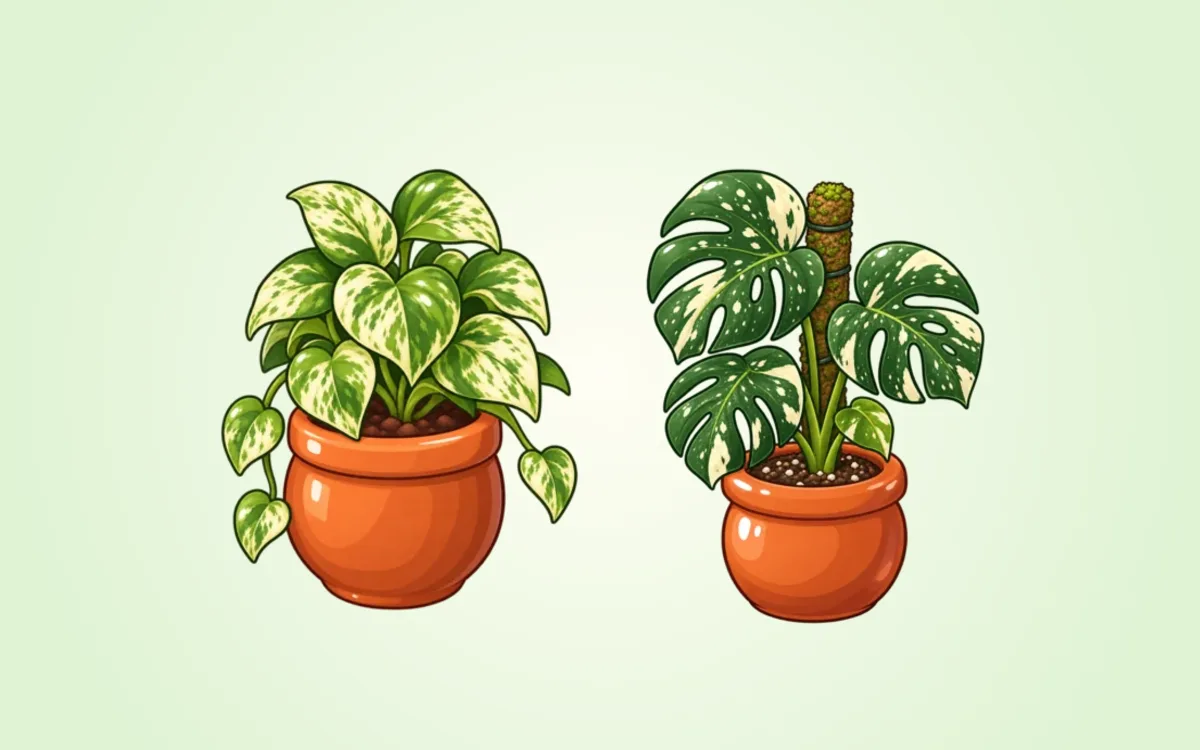
Variegated plants struggle in shade. The Missouri Botanical Garden says variegated leaves often revert to solid green when light is insufficient, and NC State Extension notes low light can cause pothos to lose its variegation. Collector aroids such as Philodendron ‘Pink Princess’ or a variegated monstera don’t belong in low light; the RHS recommends bright indirect light for philodendrons in general. Learn more in our guides to variegated houseplants and variegation reversion.
How to Care for Houseplants in Low Light
Water less often
A plant in dim light grows more slowly and uses water more slowly, so overwatering is the big risk. Water only after checking the soil, not on a schedule. NC State Extension warns that both ZZ plant and snake plant don’t tolerate wet roots. More in our guide on how to water houseplants.
Go easy on fertilizer
Clemson HGIC says foliage plants need at least 200 foot-candles for 12 hours a day before fertilizer does them any good. In low light, feed sparingly. The Missouri Botanical Garden notes overfertilizing shows up as brown, crisp leaf margins.
Make changes gradually
In the Penn State Extension article, a Chinese evergreen declined after being moved abruptly into low light. Clemson HGIC advises that any change in light intensity be gradual. Step plants down from bright spots over a few weeks.
Keep leaves clean
Clemson HGIC recommends wiping smooth leaves, top and bottom, with a soft damp cloth, and dusting hairy leaves with a soft brush. The Missouri Botanical Garden says removing dust helps the plant function more effectively.
Add light when it isn’t enough
If a plant keeps declining despite good care, add artificial light. UF/IFAS recommends fluorescent or LED lights, and Penn State Extension mentions full-spectrum LED bulbs and gooseneck LED grow lights. Clemson HGIC says 16 hours of light and 8 hours of darkness suits most plants.
Signs It’s Too Dark Even for a Shade Plant
- Leggy growth with long gaps between leaves
- Leaning toward the light
- Smaller, paler new leaves
- Very slow or no growth
These symptoms come from University of Maryland Extension and the Missouri Botanical Garden. If you see them, move the plant closer to a window or add a grow light.
Common Low-Light Mistakes
| Mistake | What happens | Fix |
|---|---|---|
| Watering on a summer schedule | Mix stays wet, risking root rot | Water only after checking the soil |
| Variegated plant in a dark corner | Leaves turn green, plant weakens | Choose plain green forms for shade |
| Feeding as if it were in bright light | Plant can’t use it; risk of overfertilizing | Feed sparingly |
| Moving a plant abruptly from a window to shade | Plant declines | Move it gradually |
| Dusty leaves | Plant functions less well | Wipe leaves regularly |
Quick Picks by Spot
- Corner far from a window, hallway with some daylight: ZZ plant, snake plant. ZZ plant can even manage under fluorescent light alone.
- North window: peace lily, heartleaf philodendron, green pothos, spider plant.
- A few feet from an east window: any of the above, plus prayer plant if you can keep the air humid.
FAQ
What is the best houseplant for low light?
According to NC State Extension, ZZ plant grows in very low light, even under fluorescent light alone, and snake plant tolerates very low light. Both still grow best in bright indirect light.
Can a houseplant live in a room with no windows?
Only with artificial light. NC State Extension says ZZ plant can manage in areas with only fluorescent light. No plant grows with no light at all. UF/IFAS recommends fluorescent or LED lights for supplemental lighting.
Why did my variegated plant turn green in low light?
The Missouri Botanical Garden notes that variegated leaves often revert to solid green when light is insufficient, and NC State Extension says low light can cause pothos to lose variegation. Penn State Extension explains that darker green leaves, with more chlorophyll, suit low light better. Move variegated plants somewhere brighter.
Should I water low-light plants less?
Usually, yes. Light is one of the main factors in how fast a plant uses water, and plants grow more slowly in dim spots. Always check the soil first. For ZZ plant, NC State Extension suggests watering about once a month in winter.
Is a north-facing window good for low-light plants?
Yes. Illinois Extension defines low-light areas as spaces near east or north windows and spots several feet from a window with no direct light. Those are exactly where the plants in this guide fit.
Sources
- NC State Extension — Zamioculcas zamiifolia
- NC State Extension — Dracaena trifasciata
- NC State Extension — Epipremnum aureum
- NC State Extension — Philodendron hederaceum
- NC State Extension — Spathiphyllum
- NC State Extension — Chlorophytum comosum
- NC State Extension — Maranta leuconeura
- NC State Extension — Aglaonema
- Penn State Extension — Low Light Houseplants
- Illinois Extension — Brighten up dim interiors with low-light houseplants
- Clemson HGIC — Indoor Plants: Cleaning, Fertilizing, Containers & Light Requirements
- UF/IFAS Gardening Solutions — Light for Houseplants
- University of Maryland Extension — Lighting for Indoor Plants
- Missouri Botanical Garden — Indoor Plants or Houseplants (factsheet, PDF)
- RHS — How to grow peace lilies
- RHS — How to grow spider plants
- RHS — How to grow philodendrons
Care information is general; every plant and home is different. Growing is simplified in the game.