 Rare Leaf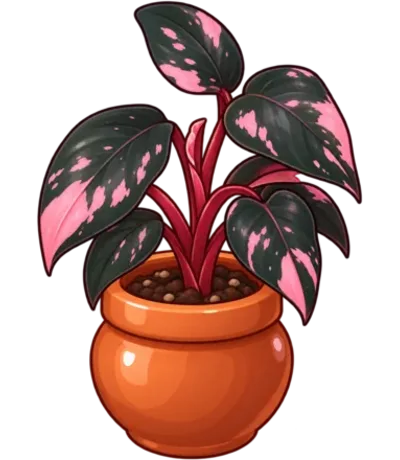
Pink Princess Philodendron Care: Light, Watering, Propagation and Keeping the Pink
Philodendron erubescens 'Pink Princess' · Araceae
Near-black leaves splashed with bubblegum pink, sometimes with a whole half of the leaf gone pink. Philodendron ‘Pink Princess’ is a climbing philodendron people buy for the color, and no two leaves look the same. Care is straightforward. The main job is giving it enough light to keep the pink coming.
How to identify it
‘Pink Princess’ is usually listed as a cultivar of Philodendron erubescens, a species native to Colombia. Singapore’s NParks database lists it that way, while the Missouri Botanical Garden describes it as a hybrid selection. Its exact parentage isn’t reliably documented.
What to look for:
- Leaves: heart-shaped to oval with a pointed tip, glossy and leathery. The Missouri Botanical Garden gives up to about 8 inches long and 5 inches wide.
- Color: dark purplish green with pink variegation that shows up as large blotches, fine streaks, or occasionally a fully pink leaf.
- Stems: bright red when young (RHS).
- Habit: slow-growing and vining. With support, a mature plant can pass 4 feet.
NParks points out that it resembles ‘Pink Congo’, which has pointier leaves and a less balanced mix of pink and green.
Light
Give it lots of bright, indirect light: an east- or west-facing window works well, or a spot set back from a south window. Direct sun burns the leaves, and the pink sections suffer first because they have no chlorophyll to protect them.
Too little light is the other common mistake. According to the Missouri Botanical Garden, heavy shade reduces variegation and causes leggy growth. If new leaves keep coming in darker, add light before anything else.
For more on picking the right spot, see our houseplant light guide.
Watering
Water once the top of the potting mix has dried. NParks recommends waiting until roughly the top 2 inches (5 cm) are dry, then watering thoroughly and emptying the saucer. Soggy soil leads to root rot, which typically shows up as yellowing leaves (RHS).
Water more generously during the growing season (roughly April to September) and cut back in winter. The RHS recommends rainwater or filtered water. NC State Extension suggests watering at the base rather than over the leaves, since wet foliage encourages leaf spot.
Our guide to watering houseplants covers the finger test and pot choice in more detail.
Soil and repotting
Philodendrons need a loose, fast-draining mix. The RHS recommends a slightly acidic blend (pH 5–6), such as two parts orchid mix to one part peat-free ericaceous (acidic) potting mix. A standard houseplant mix amended with bark and perlite also works; see our aroid soil mix guide.
Repot in spring every two to three years, or when roots fill the pot. Go up only one pot size, because a pot that’s too big stays wet too long.
Because it’s a climber, it grows best with support. A moss pole is ideal: keep it moist and the plant will eventually root into it (RHS).
Humidity and temperature
Pink Princess likes warmth. NC State Extension gives an ideal range of 65–85°F (18–29°C), and the RHS advises never letting it drop below 59°F (15°C). Keep it away from cold drafts and don’t park it right above a radiator.
Higher humidity helps, but it adapts to average indoor air. Grouping plants together or running a humidifier gives it a boost.
Fertilizer
Feed once a month during the growing season (April to September) with a balanced liquid houseplant fertilizer (RHS). Skip feeding in winter. It grows slowly, so overfeeding does more harm than good.
How to propagate Pink Princess
Pink Princess is propagated from stem cuttings, ideally between spring and late summer.
- Pick a stem with at least one leaf and one node. The node is the bump on the stem where a leaf and aerial root emerge.
- Cut with clean pruners just below a node, taking a piece about 4 inches (10 cm) long (RHS). Wear gloves because the sap irritates skin.
- Root it in water or directly in moist potting mix (NParks).
- Raise the humidity with a clear bag or propagation dome. NParks reports rooting in about 4–5 weeks.
- Pot it up once roots form, and keep it warm and in bright, indirect light for the first few weeks.
Larger plants can also be air layered, which lets the stem root while it’s still attached to the mother plant.
Color tip: the variegation on the stem and leaf near the node hints at what the new plant will look like. A cutting from an all-green section will likely grow dark. More in our article on Pink Princess philodendron care.
Why the variegation is unstable
The pink appears where the leaf lacks chlorophyll. ‘Pink Princess’ variegation is unstable: the plant can put out balanced leaves, gradually revert to dark green, or produce an almost fully pink leaf.
- Reverting to green: add light and cut back stems that have gone solid green. The Missouri Botanical Garden recommends pruning out reverted growth.
- All-pink leaves: they look stunning but can’t photosynthesize. A plant making mostly pink leaves will weaken over time.
- Pruning: the RHS recommends cutting just above a node in spring. A new shoot grows from the node below the cut.
Read more in our guide to variegation reversion.
Common problems
| Symptom | Cause | Fix |
|---|---|---|
| New leaves getting darker | too little light, reversion | move closer to a window; cut back green stems above a node with good variegation |
| Brown, crispy patches on pink areas | direct sun | move out of direct sun or filter it with a sheer curtain |
| Yellow leaves, mushy stem base | soggy soil, root rot | let the top dry before watering; check roots and repot into a chunkier mix |
| Long, bare stems | low light | more light, a moss pole, spring pruning |
| Fine webbing, pale stippling on leaves | spider mites | raise humidity, isolate the plant and treat |
| White cottony clumps in leaf joints | mealybugs | remove by hand, isolate the plant and treat |
| Brown bumps on stems | scale | scrape off, treat and isolate |
The Missouri Botanical Garden lists aphids, mealybugs, scale, thrips and spider mites as pests of Pink Princess. See our guides to spider mites, mealybugs and thrips.
Is Pink Princess toxic to pets?
Yes, it is toxic to cats and dogs. The ASPCA doesn’t list Pink Princess by name, but its closest entry for the genus (“Variegated Philodendron”) names insoluble calcium oxalate crystals as the toxic principle. Chewing the plant can cause intense burning and irritation of the mouth, tongue and lips, excessive drooling, vomiting and difficulty swallowing.
For people, NC State Extension rates philodendrons as low severity: eating the plant irritates the mouth and stomach, and the sap can irritate skin. Keep it away from kids and pets, wear gloves when pruning, and call your veterinarian if you think your pet has eaten some.
In the game
In Rare Leaf Tycoon, Philodendron ‘Pink Princess’ is one of six species. You propagate cuttings from a stable or unstable mother line and only see a new leaf’s pattern after it’s revealed, from plain green to a rare half moon. Growing is simplified in the game, and plants never die.
Variegated & notable cultivars
- 'Pink Princess' — unstable
FAQ
Why is my Pink Princess losing its pink?
Usually not enough light. The Missouri Botanical Garden notes that too much shade reduces the variegation. Move it closer to a window and cut back stems that have reverted to solid green.
Can a Pink Princess philodendron take direct sun?
No. It wants plenty of bright, indirect light, but direct sun burns the leaves, and the pink sections scorch first. Avoid harsh afternoon sun.
How often should I water a Pink Princess?
Water by feel, not by schedule. Wait until the top of the soil has dried; NParks suggests about the top 2 inches (5 cm). Water less in winter.
Can you propagate Pink Princess in water?
Yes. A cutting with at least one leaf and one node roots in water or directly in moist potting mix. Under humid conditions, NParks reports roots in roughly 4 to 5 weeks.
Is Pink Princess philodendron toxic to cats and dogs?
Yes. Philodendrons contain calcium oxalate crystals, which the ASPCA says cause mouth irritation, drooling, vomiting and trouble swallowing in cats and dogs.
Sources
- ASPCA — Variegated Philodendron (closest entry, genus Philodendron)
- NParks Flora & Fauna Web — Philodendron 'Pink Princess'
- Missouri Botanical Garden — Philodendron 'Pink Princess'
- RHS — Philodendron 'Pink Princess' (v)
- RHS — How to grow philodendrons
- NC State Extension — Philodendron erubescens
- POWO (Kew) — Philodendron erubescens
Care information is general; every plant and home is different. Growing is simplified in the game.