 Rare Leaf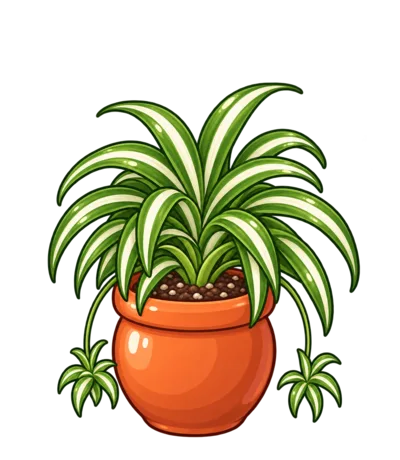
Spider Plant Care (Chlorophytum comosum): Brown Tips, Babies and Pet Safety
Chlorophytum comosum · Asparagaceae
The spider plant (Chlorophytum comosum) is about as easy as houseplants get. It forms a fountain of narrow, arching leaves and sends out long runners tipped with baby plants you can pot up for free. It’s also one of the few popular houseplants the ASPCA lists as non-toxic to cats and dogs, which makes it a go-to for pet owners.
How to identify a spider plant
Spider plants belong to the asparagus family (Asparagaceae). Kew’s Plants of the World Online gives a wide native range across tropical and southern Africa: from West tropical Africa to Cameroon, and from Ethiopia to southern Africa. The older name Anthericum comosum is now a synonym.
The leaves are long, narrow and strap-like, either plain green or striped with white or cream. Long flowering stems carry small white star-shaped flowers, and the Missouri Botanical Garden notes that plantlets form at the flowering nodes, so a mature plant looks like it’s dangling little spiders. The roots are thick and tuberous and store water, which is why a spider plant can handle an occasional missed watering.
Light
NC State Extension says spider plants prefer medium light, tolerate deep shade and don’t tolerate direct sun. The RHS adds that they cope with both bright and low light indoors, but in low light they grow more slowly and the leaves can lose their variegation. Too much direct sun turns leaves yellow or brown, and the Missouri Botanical Garden warns the foliage can scald.
NC State Extension also suggests them for hanging baskets, where the runners and plantlets can cascade freely.
Watering
The RHS advises watering regularly to keep the compost just lightly moist, and watering less in winter. University of Wisconsin Extension suggests letting the soil dry slightly between thorough waterings. The fleshy roots buffer short dry spells, but the Missouri Botanical Garden notes that waterlogged plants are prone to root rot, so empty the saucer after watering.
Water quality matters. NC State Extension warns that chlorine and fluoride in tap water cause leaf tip burn, and the RHS recommends rainwater or filtered water whenever possible.
Soil and repotting
The RHS recommends peat-free multipurpose or houseplant compost. Repot every year or two into a slightly larger pot. A badly root-bound plant loses vigor, but an oversized pot discourages flowering and plantlets.
The Missouri Botanical Garden notes the tuberous roots can bulge or even split plastic pots, so divide and repot before that happens. The RHS suggests dividing every two to three years, or simply replacing an old plant with a young one grown from a plantlet.
Humidity and temperature
NC State Extension recommends medium humidity. A pebble tray helps in dry rooms, and very dry air is one of the causes of brown tips.
Spider plants like cool to average room temperatures. The Missouri Botanical Garden gives 55–70°F (13–21°C) as ideal and says to keep them above 45°F (7°C). The RHS suggests ideally above 50°F (10°C).
Fertilizer
The RHS recommends a balanced liquid fertilizer every other month from April to September. Don’t overdo it: the Missouri Botanical Garden says heavily fertilized plants form fewer plantlets, and the tuberous roots store their own reserves.
How to propagate spider plant babies
Spider plants are very easy to propagate. You have three options.
Plantlets in soil (RHS method):
- Pick a good-sized plantlet that already has its own roots.
- Detach it from the runner.
- Pin it onto a pot of moist compost, for example with a U-shaped piece of wire.
- Keep the mix lightly moist until it roots.
Plantlets in water: Stand the plantlet in a glass of water with only the base submerged. Once the roots lengthen, pot it up on its own (RHS).
Rooting while attached: University of Wisconsin Extension suggests setting the plantlet, still attached to the runner, on the surface of a nearby pot of potting mix, then cutting the runner once it has rooted.
You can also divide a large plant into several clumps, each with its own roots.
If your plant isn’t producing babies, the RHS says it may be under a year old, short on light, too cool or in too big a pot. NC State Extension explains that runners form in response to short days: the plant needs at least three weeks of less than 12 hours of light a day with long, uninterrupted nights.
Variegated varieties
- ‘Vittatum’: medium green leaves with a wide, creamy white center stripe (NC State Extension). The RHS describes its leaves as longer and arching.
- ‘Variegatum’: green leaves edged in white or cream.
- ‘Milky Way’: a broad white or cream center with green margins.
- ‘Bonnie’: a compact type with curly, twisting leaves, also available as ‘Bonnie Variegated’.
- ‘Ocean’: described by the RHS as reverse-variegated.
- ‘Hawaiian’: NC State Extension notes the variegation shows on new leaves and fades with age.
Variegation holds best in good light. In shade, the RHS says leaves may lose their stripes.
Common problems
| Symptom | Cause | Fix |
|---|---|---|
| Brown leaf tips | fluoride and chlorine in tap water, over- or underwatering, dry air, strong sun | rainwater or filtered water, steady watering, trim the tips |
| Yellow or scorched leaves | direct sun | move to indirect light |
| Stripes fading | low light | brighter spot |
| No plantlets | young plant, low light, oversized pot, too much fertilizer | wait, more light, smaller pot, feed less |
| Wilting, rot at the base | waterlogged soil | let it dry out, empty the saucer |
| Small insects on new growth | aphids, whiteflies | the RHS says to wash aphids off as soon as you see them; check leaf undersides |
The Missouri Botanical Garden also lists spider mites and scale.
Toxicity
The spider plant is one of the few popular houseplants the ASPCA lists as non-toxic to dogs and cats in its plant database (under both Chlorophytum comosum and Anthericum comosum). NC State Extension lists it as non-toxic to cats, dogs and horses. For completeness: one ASPCA article calls the spider plant mildly toxic, noting that small ingestions can cause mild gastrointestinal irritation. The ASPCA also reminds pet owners that eating any plant can cause vomiting and stomach upset. If your cat keeps chewing the leaves, move the plant higher and watch for digestive upset. See houseplants toxic to cats and dogs.
Variegated & notable cultivars
- 'Vittatum' — cultivar
- 'Variegatum' — cultivar
FAQ
Are spider plants safe for cats?
The ASPCA plant database lists the spider plant as non-toxic to cats and dogs, and NC State Extension lists it as non-toxic to horses too. One ASPCA article notes that eating small amounts can still cause mild stomach upset.
Why are the tips of my spider plant turning brown?
The RHS lists several causes: too much or too little water, fluoride in tap water, strong sun or very dry air. Switch to rainwater or filtered water and trim off the brown tips if they bother you.
Why isn't my spider plant making babies?
Most spider plants don't flower or produce plantlets until they are at least a year old. The RHS says low light, cool temperatures and an oversized pot also hold them back. NC State Extension adds that plantlets form after at least three weeks of short days with under 12 hours of light.
How do you root spider plant babies?
Detach a plantlet that already has roots and pin it onto moist potting mix, or stand it in a glass of water and pot it up once the roots lengthen. You can also root it in a pot next to the parent before cutting the runner.
Can spider plants grow in low light?
They tolerate a lot of shade, but grow more slowly and variegated types can lose their stripes. Direct sun scorches them. Medium to bright indirect light is best.
Sources
- ASPCA — Spider Plant (Chlorophytum comosum)
- POWO (Kew) — Chlorophytum comosum
- RHS — How to grow spider plants
- NC State Extension — Chlorophytum comosum
- Missouri Botanical Garden — Chlorophytum comosum
- University of Wisconsin–Madison Extension — Spider plant
- ASPCA — Is That Houseplant Safe for Your Pets?
- ASPCA — Toxic and Non-Toxic Plants (general notes)
Care information is general; every plant and home is different. Growing is simplified in the game.